The First Ghost Hunter
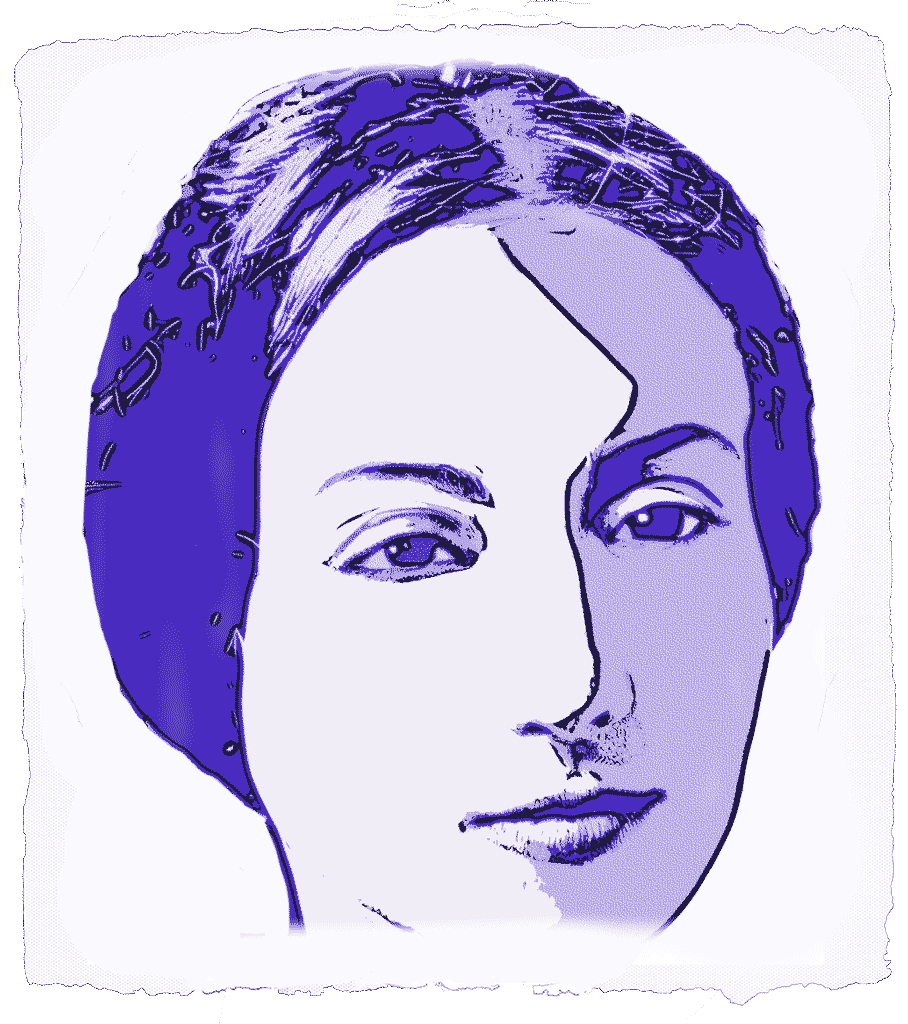
Poltergeists. Doppelgängers. Twin Telepathy. Everyone in the paranormal has been influenced by Catherine Crowe. They just don’t know it yet. In fact, Catherine Crowe could easily be called the mother of paranormal investigation.
Catherine Crowe (1790-1872) was an English mystery novelist and writer known for her works on supernatural phenomena. She was the first to write about poltergeists and doppelgängers in the English language. Her wide-ranging paranormal documentation provided some of the earliest accounts of twin telepathy, Out-of-Body Experiences (OBE), Near-Death Experiences (NDE), and a variety of ghostly phenomena to Western readers.
This updated resource guide aims to put all relevant information about Catherine Crowe’s contributions to fields of paranormal study in one place.
What did Catherine Crowe do that was so influential?
- Catherine Crowe made international discoveries more accessible.
- Catherine Crowe introduced key concepts, opening them up for paranormal study.
- Catherine Crowe conducted the first single-blind study of a haunted house.
1. Catherine Crowe made international discoveries more accessible.
English mystery writer Catherine Crowe became fascinated with the work of German doctors and scientists who dared look into the realm of unexplained phenomena beginning in the 1820s. Catherine strived to make their research available to ordinary English readers by writing two non-fiction books.

To share fascinating discoveries of German paranormal researchers, Catherine translated Dr. Justinus Kerner’s book, The Seeress of Prevorst, about an extraordinary psychic patient and her communications with the spirit world into English in 1845.
Catherine went to write her own book about a broader range of unexplained phenomena in 1848. The Night-Side of Nature became immensely popular. The 400-page book combines the stranger elements of classical history, shares discoveries by top German researchers, and compiled worldwide paranormal accounts from the present day to antiquity.
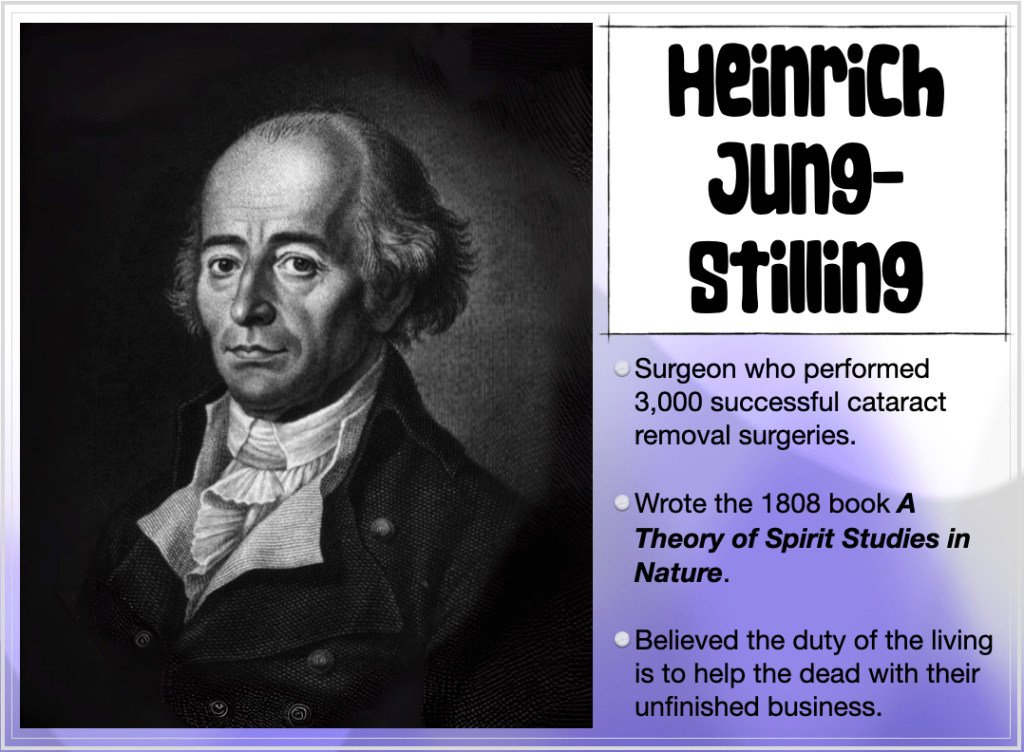
Catherine’s influences included Justinus Kerner, Heinrich Jung-Stilling, Karl Eschenmayer, Joseph Ennemoser, and Gotthilf Heinrich von Schubert. Watch a full presentation on Catherine Crowe’s life and work below.
2. Catherine Crowe introduced key concepts, opening them up for paranormal study.
We all know that person who claims that they were doing it before it was cool. But Catherine Crowe was the real deal.
In 1848’s The Night-Side of Nature, Catherine acquainted readers with incredible accounts of many unexplained phenomena which are the mainstay of paranormal investigation and parapsychology research today including:
- A wide variety of ghostly phenomena.
- Poltergeists and doppelgängers.
- Out-of-Body-Experiences.
- Near-Death-Experiences.
- Demonic Possession.
- Twin Telepathy.
- Electric People.
3. Catherine Crowe conducted the first single-blind study of a haunted house.
Enlisting the help of a clairvoyant, Catherine pioneered secular ghost hunting as we know it today. Although ghosts weren’t mentioned, the psychic, a young girl, must have had her suspicions.
She was only told that Catherine and her friends wanted her impressions of a piece of real estate. However, the midnight arrival at the house in question seems more than a little suspect at least to the modern reader.

Still Catherine’s non-religious approach to paranormal investigation was a big step. Previous inquirers into hauntings were priests or pastors, searching for manifestations of the evil.
17th clergyman Joseph Glanvill is often misrepresented as the first thinker to take a scientific interest in the study of the paranormal. Glanvill was actually seeking proof that the maleficent power of witchcraft was at work in the world.
In the famous case of the Drummer of Tedworth, Glanvill concluded that what some modern researchers identify as poltergeist activity was actually a curse perpetrated by a vengeful degenerate. In fact, Glanvill’s spiritual call to action entitled Saducismus Triumphatus later inspired Cotton Mather’s Wonders of the Invisible World. Keeping this in mind, it becomes clear that a vast ontological chasm separates archaic witch-hunting hysteria and the scientific study of the paranormal. It’s quite a stretch to consider them the same thing.
So why isn’t Catherine better-known today?
Catherine has sadly fallen into obscurity because she was sidelined by a trumped up scandal. It’s been well over 150 years and unfortunately we still don’t read beyond the headlines.
Enemies in High Places
In the winter of 1854, for reasons that aren’t exactly clear, rumors began to spread that Catherine had been found wandering in the nude in the streets of Edinburgh despite the February chill. The chattering gossips behind this scandal were none other than Charles Dickens and his friends.
Dickens accused Catherine of incurable insanity and alleged she had been incarcerated in a mental institution. Due to Dickens’ fame and his high position in society, he didn’t need to supply any evidence to support his claims. Such damaging allegations, no matter how baseless, still made their way into prominent newspapers and popular journals.
In reality, the men in white coats didn’t lock up Catherine and throw away the key. It was the man in the black coat, Charles Dickens, who fabricated the bulk of the story. And it wouldn’t be the last time. Later Dickens would employ mad-shaming for his own gain again. Posthumous evidence suggests the Dickens’ next target was the mother of his children.
Dickens famously burned all of his papers before his death. But he didn’t get everything. Existing letters document an unsuccessful attempt to institutionalize his wife when his marriage vows became too tiresome.
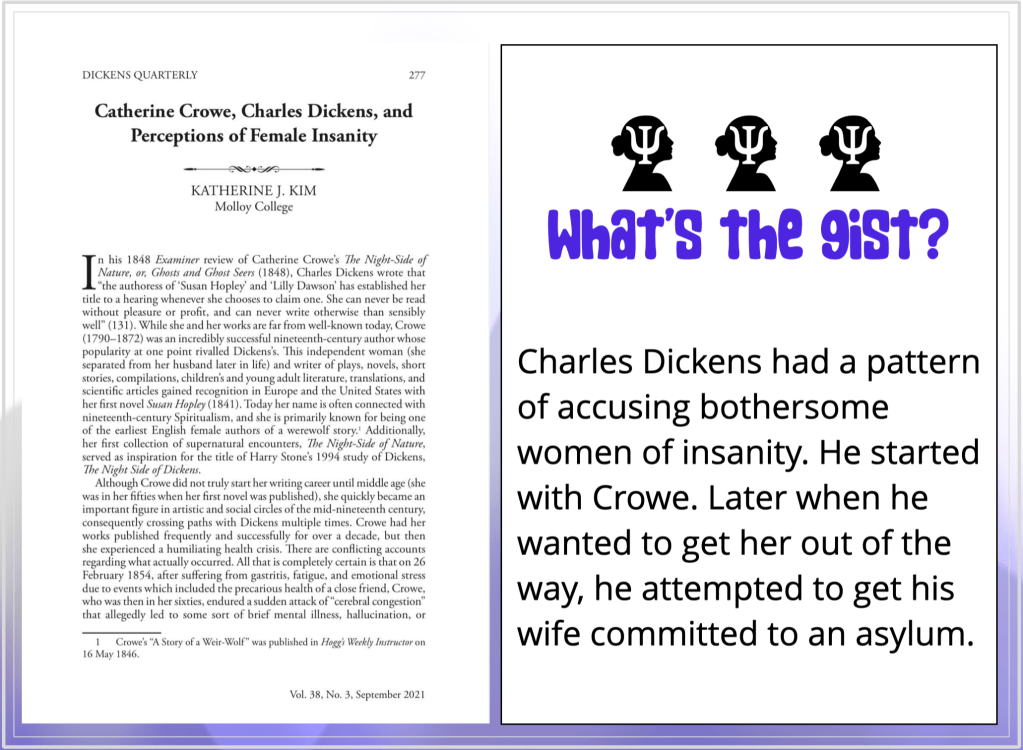
However, in Catherine’s case, the evidence demonstrates continued productivity and respectable behavior. Catherine persisted, writing both fiction and non-fiction books and articles for roughly another two decades until her death in 1872, at the age of 82.
Although Catherine Crowe has largely gotten the cold shoulder from the paranormal community, academics have been writing thoughtfully about her for years. Mainstream journalists, however, continue to fail and get Catherine’s story wrong.
As is too often the case, writers uncritically copy others because it’s much quicker and easier than having an original thought. As for readers, they typically don’t let facts get in the way of a good story.
To this day, over 150 years later, the same unsubstantiated gossip about Catherine Crowe spreads, unconsciously repeated by many, including historians who should know better. The most recent smear appeared unchallenged in the Edinburgh Evening News in 2021. If you’d like to challenge his assertions, please reach out to the author Jan Bondeson and let him know what you think.

Read More . . .
- The Seeress of Prevorst (1845)
- The Night-Side of Nature (1848)
- Ghosts & Family Legends (1859)
 PARANORMAL WOMEN: A Hidden History