Parapsychologist to the Stars
University-level parapsychology. It’s mostly the stuff of legend in the United States. But for ten years one woman led an incredibly high-profile lab at UCLA.
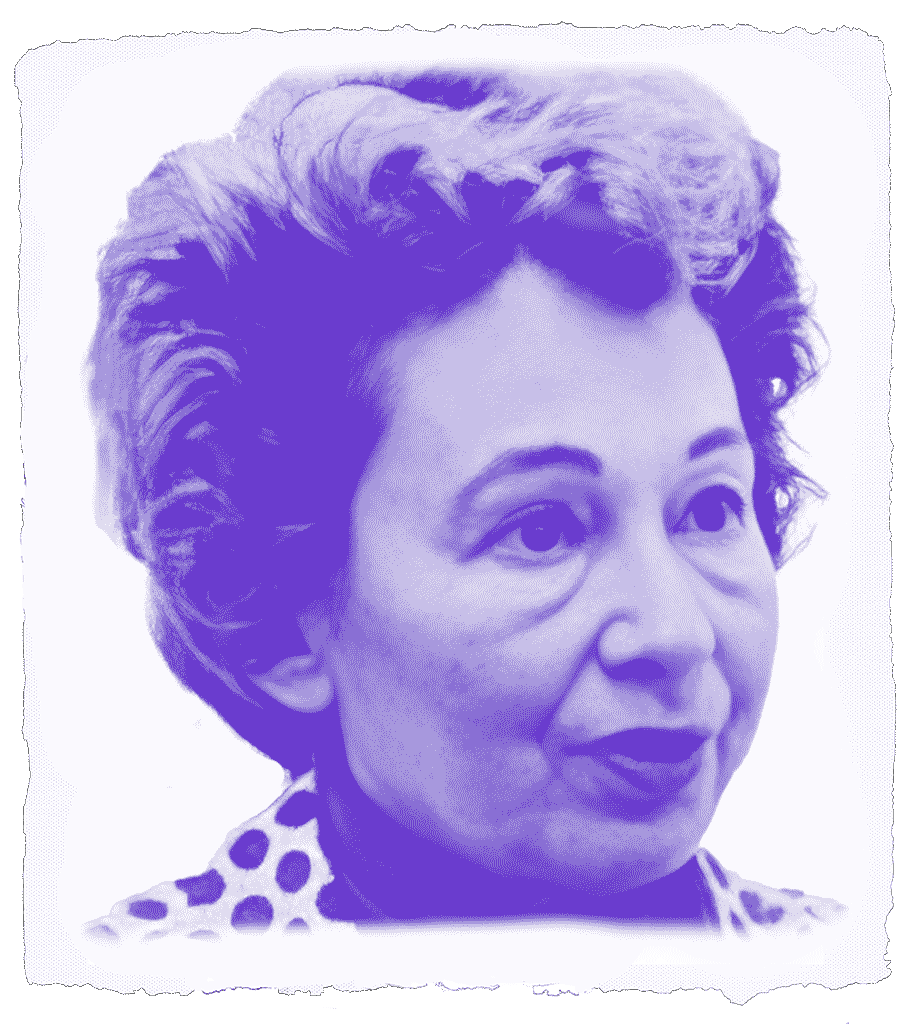
Thelma Moss (1918-1997) began her career as an actress and screenwriter. But following the death of her husband shortly after the birth of their daughter, Moss faced profound depression, leading her to undergo LSD-assisted psychotherapy. This transformative experience inspired her to pursue psychology, earning a Ph.D. from UCLA. She later became a professor and led UCLA’s parapsychology laboratory in the 1970s.
This updated resource guide aims to put all relevant information about Thelma Moss’s contributions to fields of paranormal study in one place.
What did Thelma Moss do that was so influential?
- Thelma Moss ran a parapsychology lab that attracted movie stars and rock legends.
- Thelma Moss promoted the positive effects of LSD-assisted therapy on mental health.
- Thelma Moss trained other acclaimed parapsychologists.
1. Thelma Moss ran a parapsychology lab that attracted movie stars and rock legends.
Los Angeles is home to many star-studded ghost stories. For a decade its esteemed college, the University of California – Los Angeles (UCLA) also housed a parapsychology lab run by parapsychologist Thelma Moss, a former actress and screenwriter.
Parapsychologists are scientists and academics who specialize in the study of paranormal phenomena. Think the Ghostbusters minus the proton packs. Plus they really exist.
Dan Aykroyd actually got the idea for Ghostbusters by reading real scientific journals about parapsychology. (His family has been involved in psychical research for generations. He even wrote a book with his father called A History of Ghosts.)
Thelma Moss began her career as an actress on Broadway and a founding member of the Actor’s Studio in New York. Her transition into screen-writing brought her to Los Angeles, where she penned numerous television scripts, including episodes for the daring One Step Beyond, and the screenplays for two notable movies.
In 1954, she co-wrote the the mystery comedy Father Brown, based on a short-story by G. K. Chesterton, starring Alec Guinness in the titular role. Essentially the future Obi-Wan Kenobi chases an art thief around France. A particularly entertaining scene finds Father Brown in quite a pickle, when his nemesis overpowers him in the Paris Catacombs and ties him up against a pile of bones.
One startling moment involving Alec Guinness was surely an influence on Thelma’s later decision to study parapsychology. In his memoirs, entitled Blessings in Disguise, Alec tells the story of an evening when he met Thelma Moss for dinner in Los Angeles.
At a little Italian bistro named Villa Capri they find no tables available and leave discouraged. But James Dean comes to the rescue, following them outside and inviting them to join him at his table. On the way back to the restaurant, bursting with pride, James Dean draws their attention to his new sports car in the parking lot.
Despite James Dean’s boyish enthusiasm, like a true Jedi master, Alec Guinness gravely blurts out, “Please never get in it. It is now ten o’clock, Friday the 23rd of September, 1955. If you get in that car you will be dead in it by this time next week.”
Catching himself, Alec swiftly apologized, blaming his strange outburst on jet-lag from an international flight. Thelma, Alec, and James went on to have a lovely dinner.
Unfortunately, James Dean wouldn’t take Alec Guinness’s spooky advice to heart. By 4 p.m. the following Friday, James Dean was indeed dead, killed in an accident in his new sports car.
In 1958, Thelma wrote an iconic brain in a jar movie, a sci-twist on Frankenstein, entitled The Colossus of New York. Although it was based on a story by Willis Goldbeck, you can definitely see Thelma’s influence on the screenplay.
Through the tale of a humanitarian scientist who runs amok when his brain is transplanted into a 8-foot cyborg, the story posits a deeper theme. Even the most charitable among us can become monsters when cut off from the grounding influence of human feeling.
The Colossus seems the likely inspiration for Robotman in the Doom Patrol comic and television series. However, Thelma’s clunky pile of metal and bolts has considerably less of charm than Doom Patrol’s Cliff Steele, with no capacity for his introspection and sweetness.
Under Thelma’s creative guidance, the technological golem in The Colossus of New York develops strange mental powers including Svengali-like hypnosis, allowing him to control the minds of others, and powerful death-rays shooting from his eyes. In another time and place, Thelma and, Doom Patrol author, Grant Morrison would have been great friends.
Once Thelma obtained a position at UCLA teaching medical psychology in 1966, she established a largely unsanctioned and unfunded, yet wildly popular and internationally famous laboratory dedicated to the scientific study of paranormal phenomena. Thelma was a strong advocate for psychical research, with an unwavering belief that the scientific method could be applied to this often-misunderstood field.
Thelma is best known today for her research into the Russian phenomenon of Kirlian photography. However, she conducted experiments on a variety of other paranormal topics such as extrasensory perception, psychokinesis, and hauntings.
Thelma had hoped Kirlian photography, which creates astounding images, resembling religious halos and the legendary aura, could be used to revolutionize the diagnosis of serious illnesses like cancer. Although the research itself was controversial, Thelma’s efforts to collaborate with Russian scientists during the Cold War, including many visits to the USSR, earned her the Douglass Dean award from the United Nations in 1976.
Thelma also wrote two books about her research, The Probability of the Impossible in 1974 and The Body Electric in 1979. Her lab attracted as much attention from Hollywood stars as mediums Tyler Henry and James Van Praagh do today. Unfortunately, since most of the actors and directors involved in the lab’s research wanted their names kept confidential, we’ll probably never know most of their identities. However, rock legends David Bowie and George Harrison were less elusive.
According to Barry Taff, in one tragic incident, research subjects at the lab predicted the murder-suicide perpetrated by character actor Albert Salmi. His career included roles in many films including Escape from the Planet of the Apes, Caddyshack, and Dragonslayer. He also appeared in numerous TV shows such as Gunsmoke, Lost in Space, and The Twilight Zone.
Albert Salmi’s second wife Roberta, who only visited Thelma’s lab out of casual curiosity, brushed off the psychic’s dire advice. Many years later, in April 1990, just as the lab’s psychics had foreseen, Roberta was fatally shot by Albert, before he turned the gun on himself.
On a lighter note, Carol Burnett wrote about her visit to Thelma’s lab in her memoir, entitled In Such Good Company: Eleven Years of Laughter, Mayhem, and Fun in the Sandbox.
Thelma devised a special experiment just for Carol. Thelma photographed Carol’s fingertips using the Kirlian technique to get a baseline reading.
Carol was intrigued by the initial photograph that captured “shooting lights surrounding each finger.” Then Thelma asked Carol to pick a persona from the long list of characters she portrayed on The Carol Burnett Show, her long-running sketch comedy hit. Carol was to secretly take on the feelings each character one-by-one.
For each character, Thelma snapped a new Kirlian photograph and each aura was dramatically different. Eunice’s anger and frustration was demonstrated in an aura which was very “close to her fingers” with no shooting lights.
At the other extreme was Chiquita (a parody of the vivacious and ubiquitous 70s flamenco guitarist and all-round entertainer Charo). Her “aura was shooting out all over the place.” The aura of the deranged has-been silent film actress Nora Desmond was “uneven and kind of spikey.”
Carol was amazed when Thelma was able to correctly identify all the characters by personality, simply by examining the differences in the light emanations or auras in the photos. Carol’s story so impressed actor Alan Arkin that he included it in his memoirs as well.
In Finding Peter: A True Story of the Hand of Providence and Evidence of Life After Death, William Peter Blatty, author of The Exorcist, tells of the time that he and director Billy Friedkin visited Thelma’s lab as part of their research for the film. Thelma had arranged for them to meet with a young police officer, a percipient who had demonstrated the power of psychometry, the ability to read objects psychically.
Without explanation, William presented the psychic a religious medal, which had belonged to his late mother. Although the psychic provided a detailed description of a white frame house with a white fence near a railroad and a black and white dog, William was disappointed by the reading since the images seemingly had no relevance. However, months later, he was shocked by the exact match when he asked his older sister to describe where the family lived in Lebanon before he was born.
Thelma’s lab also attracted the interest of such 70s psychic luminaries as Uri Geller and Carlos Castaneda. This popularity inevitably led to Thelma Moss’s downfall in 1978, when due to all the resulting publicity, UCLA closed her lab was and terminated her position.
Thelma continued her work privately, but suffered a massive cerebral aneurysm in the late 1980s. She passed away in 1997, at the age of 79. Her influence on Hollywood still lives on in the classic paranormal movies she consulted on: The Exorcist, Poltergeist, and Ghost.
2. Thelma Moss promoted the positive effects of LSD on mental health.
In her 1997 obituary, London newspaper The Guardian dubbed Thelma Moss “The Apostle of LSD,” stating “Huxley and Leary’s praise of LSD in the fifties pales beside a contemporary, best-selling account by a middle-aged woman, Thelma Moss.”
When Thelma’s husband, movie producer Paul F. Moss, died just days after the birth of their daughter in 1954, it changed the course of her life. Thelma plunged into a deep depression and attempted suicide twice.
Finding other psychiatric treatment lacking, Thelma sought out the opportunity to undergo 23 sessions of LSD-assisted therapy, which changed her life. She was so moved she wrote a book to share the deeply personal experience of her recovery entitled My Self and I, under the pseudonym Constance A. Newland, published in 1962.
Thelma’s recovery was a rebirth which led her to explore fresh territory. It’s the reason she abandoned a successful career in what she called “slick fiction” and went back to school, where she earned a doctorate in psychology.
Thelma’s new mission was to explore fringe topics and techniques, which like LSD-assisted therapy, might someday become groundbreaking methods to heal the body and soul of humanity. Today, as psychedelic treatments are again gaining favor in medicine with the trailblazing work at the Imperial College-London and Johns Hopkins in the U.S., My Self and I deserves another look.
By the time Thelma achieved her PhD, using LSD, even in medical treatment, was quickly becoming criminalized. Unfortunately this all largely thwarted Thelma’s plans to study the effects of psychedelics on psychic experience.
3. Thelma Moss trained other acclaimed parapsychologists.
Several of Thelma’s students are still influential today. Judith Orloff, a board-certified psychiatrist, and an associate clinical professor in psychiatry at UCLA, is a best-selling self-help author who often writes on the topics of intuition and empathy.
Thelma also trained the well-known parapsychologists Barry Taff and Kerry Gaynor, who worked together to investigate nearly 500 reportedly haunted locations around the Los Angeles area.
In the world of parapsychology, a field of study that attempts to understand and explore the unexplained, parapsychologists Barry Taff and Kerry Gaynor became a media sensation in the 1970s. If not the first, they were at least, the most active and well-known ghost hunters in L.A. in recent history.
Easily the most famous case investigated by Barry and Kerry is the Doris Bither case. In 1974, Doris Bither reported the alarming phenomena she was experiencing at her Culver City home. She claimed that she was being abused by three violent entities.
Barry and Kerry’s experiences at Doris’s house spawned the book and 1982 movie The Entity, starring Barbara Hershey. Both were written by Frank De Felitta. The movie follows the story of a woman who is tormented by unseen entities. While the movie takes some creative liberties, according to Barry, it is largely based on the events of the Doris Bither case. Although Barry and Kerry profited from consulting on the movie, their mentor Thelma Moss panned it as the “worst kind of sensationalism.”
In 2010, Barry Taff wrote a book about his paranormal experiences and investigations entitled Aliens Above, Ghost Below. Most of Kerry’s cases are less well-known. One of Kerry’s cases had a startling resemblance to the Doris Bither case.
The claimant in this case, a woman from the Midwest, reported the continuing appearances of hooded figures around her bed at night. In one instance, the woman claimed one figure overtook her with its cold, clammy, three-fingered hands. According to Kerry “it dragged her over towards the window,” but thankfully gave up, when her leg became stuck, and vanished.
In Kerry’s own experience sometimes ghosts got a little too close for comfort. In an interview he admitted, “I’ve never been harmed, but I have been grabbed, pushed, slapped, had pencils knocked out of my pocket. I’ve had my leg grabbed onto and held for about a minute, and that is a terrifying experience.”
Not all ghosts were so scary, however. Kerry jokingly dubbed one of his cases the “rent-a-geist.” This helpful ghost rearranged the kitchen at night and washed the dishes.
Kerry most famously investigated the now notorious Sallie House for the TV show Sightings in 1990s. This case is well-known for the mysterious scratches that appeared on the homeowner’s body during Kerry’s investigation.
Read More . . .
- My Self and I (1962)
- The Body Electric (1979)
 PARANORMAL WOMEN: A Hidden History