
The Voodoo Anthropologist
Zombies are real. In Haitian culture, they have been feared for centuries. In 1936, anthropologist and writer, Zora Neale Hurston investigated.
Zora Neale Hurston (1891-1960) was an influential American author, anthropologist, and filmmaker associated with the Harlem Renaissance. She is renowned for her works that celebrate African American culture and folklore, particularly in the rural South. Her paranormal work focused on the religious and magical practices of the rural South, the Bahamas, Jamaica, and Haiti.
This updated resource guide aims to put all relevant information about Zora Neale Hurston’s contributions to fields of paranormal study in one place.
What did Zora Neale Hurston do that was so influential?
- Zora Neale Hurston studied hoodoo practices in New Orleans.
- Zora Neale Hurston embedded herself in Caribbean voodoo culture.
- Zora Neale Hurston investigated zombification practices in Haiti.
1. Zora Neale Hurston studied hoodoo practices in New Orleans.
Zora Neale Hurston was an American writer and anthropologist, who immersed herself in the African-American culture of the deep South beginning in the mid-1920s. She would spend about the next twenty years studying with conjure doctors in the American South as well as practitioners of Obeah in the Bahamas and Jamaica and Vodoun in Haiti.
Zora trained with several so-called two-headed doctors in the American South. These master conjurers played both sides, the light and the dark, providing medicines, but also engaging in hoodoo, a type of sympathetic magic. One of her teachers was Luke Turner, nephew and protege of Marie Laveau, the notorious Voodoo priestess of New Orleans.
Zora endured many challenging initiations under her various mentors. In one initiation, she fasted naked for 3 days, laying prone on a couch with her navel pressed up against the shedded skin of a snake. She reported that after 69 hours and 5 psychic experiences she felt no hunger, but only exultation. Sadly, Zora did not expound on the details in any writing which I can find.
Zora’s mentor dubbed her the Rain Bringer and told her that spirits would speak to her through storms from that point onward. To conclude the ritual, the image of a lightning bolt was painted across her back. This conferred ability to commune with spirits and storms would come in handy. It may have even saved her life. But more on that later.
Zora claimed that Luke Turner asked her to stay on and take over his practice when he retired. However, this did not come to pass. Once Zora had completed her training, she decided to go on to research West African religious practices in the Bahamas, Jamaica, and Haiti.
2. Zora Neale Hurston embedded herself in Caribbean voodoo culture.
Zora began collecting African-American stories, songs, and other cultural practices under the guidance of her anthropology professor at Columbia University in New York City. Her teacher was none other than the esteemed Franz Boas, who would later become known as the “Father of American Anthropology.”
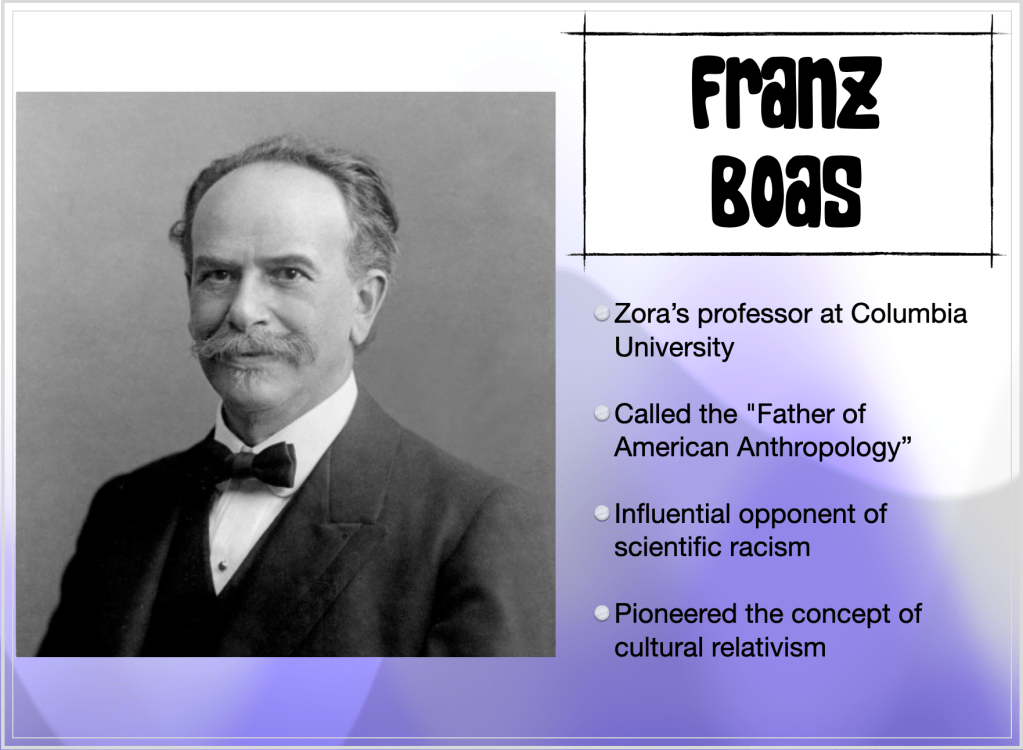
Franz Boas was an influential opponent of scientific racism, who pioneered the concept of cultural relativism. He inspired Zora to return to her childhood home in Eatonville, Florida to record the stories, customs, and songs of the community. Eatonville, Florida is the oldest all-black town in the U.S. While there, Zora documented what she found not only in her writing, but also on film. She shared her discoveries in her 1935 book, Mules and Men, as well as audio recordings and, even, dance recitals before taking a detour to embed herself in Caribbean voodoo culture.
After her time in Florida and Louisiana, Zora left the U.S. to explore the customs of the Caribbean. Her first stop was the Bahamas.
It was October 1929 and Zora was scheduled to stay for two weeks on an expedition to film traditional dances when something terrible and unexpected transpired.
She found herself trapped in the middle of a deadly hurricane.
Hunkered down with her host family, waiting out the storm, which had been going on for days, Zora suddenly received a psychic premonition that they needed to immediately flee the house. Although it seemed counterintuitive to leave the safety of the shelter behind, her companions followed Zora out into the lashing wind and rain. It’s a good thing they did. Seconds later the house collapsed into a pile of dangerous rubble.
“I saw dead people washing around on the streets when it was over.”
~ Zora Neale Hurston
Many other victims of the storm in Nassau lost their lives that day. More than 300 houses were destroyed and the bodies of the dead littered the streets. But Zora had been saved by the spirits, or so she believed.
Her traumatic experience in the hurricane and its aftermath inspired the climax of Zora’s most famous novel Their Eyes Were Watching God. In 1930, Zora was able to return to the Bahamas, to finish her fieldwork, which was published in an article entitled “Dance Songs and Tales from the Bahamas” in the Journal of American Folklore.
Zora went on to visit Jamaica and Haiti. In Jamaica, she uncovered the traditions associated with local ghosts called duppies. A misleadingly adorable name for evil remnants of the personality who often stick around after death to torment the living. Zora also attended a ceremony intended to appease these spirits called the Nine Night.
In Haiti, Zora trained with priests and priestesses of the Vodoun religion. She documented her incredible paranormal adventures in the Caribbean in the 1938 book, Tell My Horse. For a retelling of some of the remarkable stories therein, listen to this episode of the 6 Degrees of John Keel podcast.
3. Zora Neale Hurston investigated zombification practices in Haiti.
During her time in Haiti, Zora reached out to prominent members of the local community in an attempt to document zombification practices. In response, correspondents in the medical field invited her to meet a zombie, an inmate at a local asylum.
But this was no monster. In fact, she was a victim and she had a name. Her name was Felicia Felix Mentor.
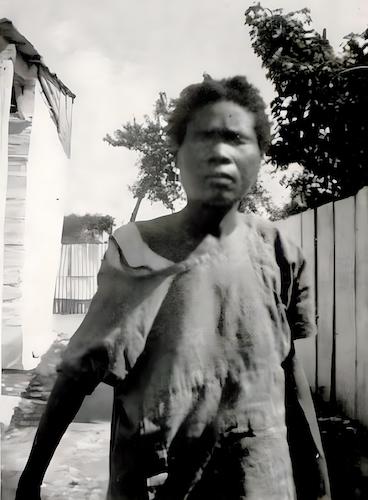
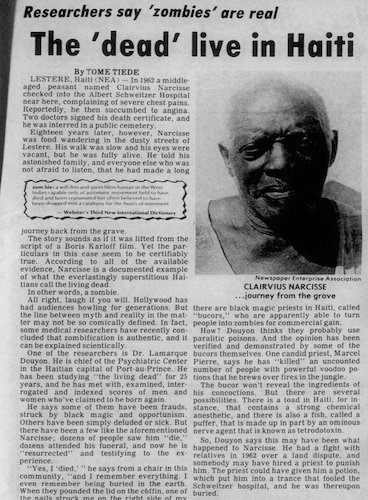
The photo on the left was taken by Zora in 1936. It’s Felicia Felix Mentor in the yard of the asylum as she appeared on the day of their meeting on October 24, 1936. (Another possible zombie, Clairvius Narcisse, is pictured on the right as he appeared in 1985. Some internet sources mistakenly identify the picture of Felicia on the left as Clairvius.)
In contrast to the typically blood-thirsty (or brain-hungry) depictions of zombies, Felicia was a cowering, polar opposite of aggression. Her responses were characteristic of trauma.
When Zora and the doctors approached, Felicia shrunk back, stumbling away and grabbing a bristly branch. But instead of brandishing it like a weapon, Felicia kept her head down and her eyes lowered. She employed the branch as a make-shift broom and began frantically sweeping the general area.
Doctors concluded that Felicia demonstrated the behavior of a slave who had been severely abused. They explained her strange actions as attempts to avoid corporal punishment.
Felicia Felix Mentor apparently died in 1907. By the time she reappeared, naked limping down a rural road in 1936, nothing was left of the life she had once known. Though her brother recognized her as his long-deceased sister, there was no way for her to reclaim what had been lost.
There was no longer a place for such a wretch in the community. Felicia’s former husband wanted nothing to do with her. Her son, who had grown up long ago, had no memory of her. With Felicia’s family essentially gone, her mind scrambled irrevocably, the only home for her was the poorly funded institution where she met Zora.
So what is a zombie? Although Zora had her share of paranormal experiences, she didn’t believe zombies were a supernatural phenomenon. However, she did believe they were created for a specific purpose.
Death was simulated to cause fear and facilitate the removal of victims from society. The perpetrators of zombification would revive these victims later, away from prying eyes. Zora portrayed zombification as a form of slavery.
Zora was already very familiar with the pharmacological acumen of the conjurers in the American South, so she hypothesized drugs were involved. One substance would be used to induce a convincing facsimile of death and another to revive the victim. Continued doses of this second drug would be used to ensure the zombie’s perpetual subservience.
Zora was determined to uncover the origins and ingredients of the zombie poisons she was sure was responsible for Felicia’s fate. However, all Zora’s Haitian friends warned her to leave it alone. They felt further investigation could lead Zora to an untimely end.
Zora was told in no uncertain terms, that powerful people were involved who wouldn’t take kindly to a nosy journalist poking around. Although Zora wasn’t typically easy to dissuade, when a psychic premonition also confirmed she was in imminent danger, she took notice. When the spirits spoke, Zora was compelled to listen. She left Haiti immediately.
It wasn’t until decades later when anthropologist Wade Davis, author The Serpent and the Rainbow would uncover the secrets of zombification. Although Wade Davis wrote glowingly of Zora and gave her credit for paving the way for his discoveries, others were too quick to forget her.
“. . . the indomitable Zora Neale Hurston provided a critical clue . . .”
~ Wade Davis
Read More . . .
- Mules and Men (1935)
- Tell My Horse (1938)
 PARANORMAL WOMEN: A Hidden History