
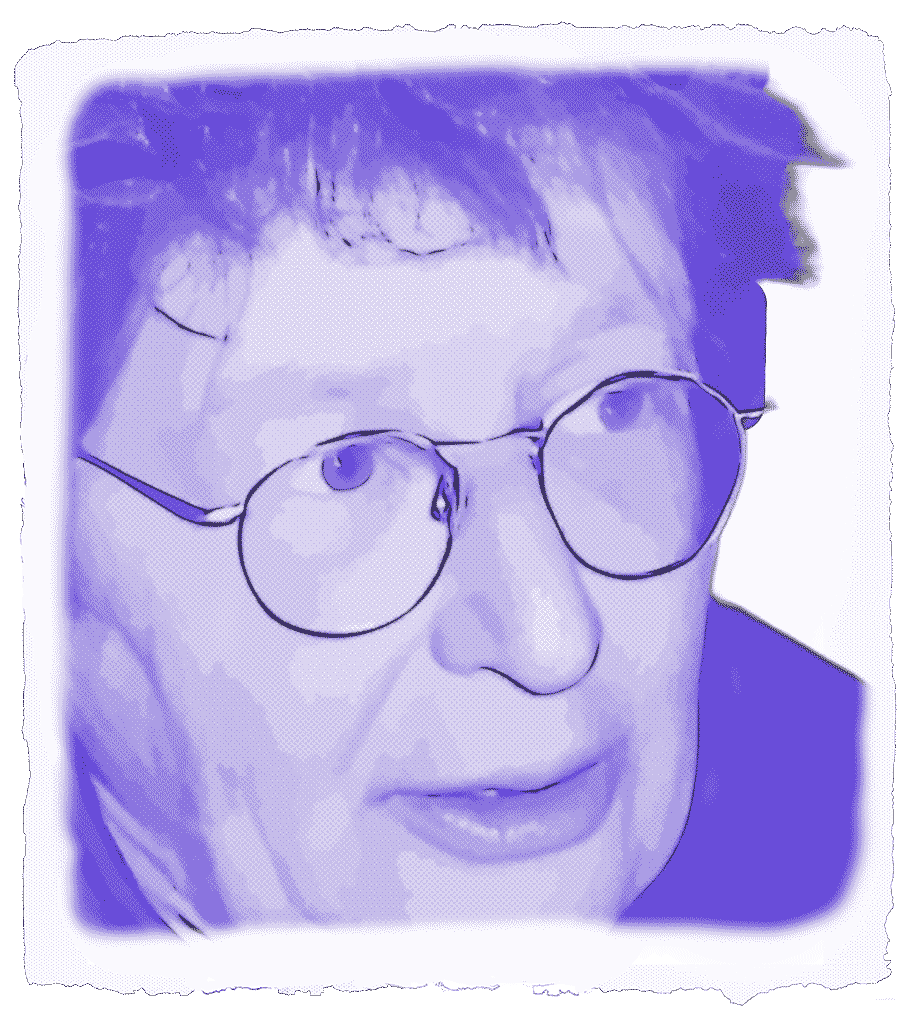
Almasty Research Pioneer
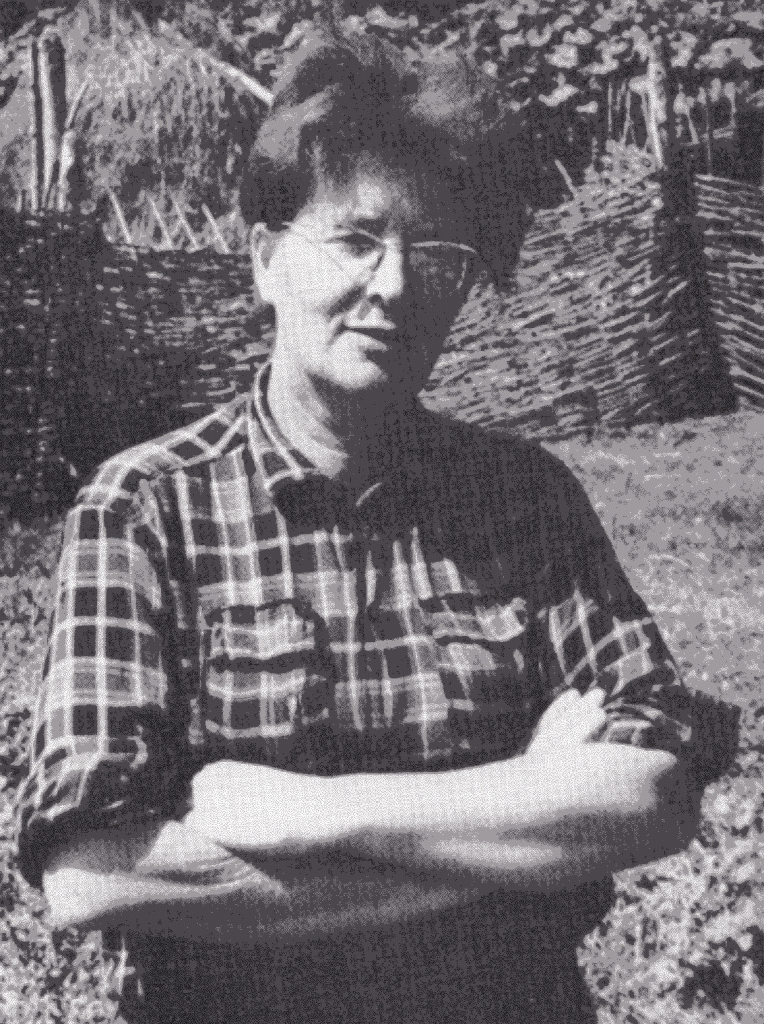
Marie-Jeanne Koffmann (1919-2021) was a French-born cryptozoologist who spent most of her life in the Soviet Union, becoming one of the leading researchers of the almasty, a purported wildman of the Caucasus Mountains. Her groundbreaking work in the field of cryptozoology made significant contributions to the study of unknown hominids.
This updated resource guide aims to put all relevant information about Marie-Jeanne Koffmann contributions to fields of paranormal study in one place.
What did Marie-Jeanne Koffmann do that was so influential?
- Marie-Jeanne Koffmann conducted extensive field research on the almasty.
- Marie-Jeanne Koffmann developed a detailed composite description of the almasty.
- Marie-Jeanne Koffmann proposed the almasty could be a relic hominid population.
1. Marie-Jeanne Koffmann conducted extensive field research on the almasty.
Born in France in 1919, Marie-Jeanne Koffmann moved to the Soviet Union in 1935 where she worked as a surgeon in Moscow hospitals1. In the 1950s, she became interested in reports of the almasty, particularly in the Kabarda region of the Caucasus Mountains. Over the course of several decades, Marie-Jeanne recorded hundreds of eyewitness accounts of the creature, collecting a vast amount of testimonial evidence.
Her meticulous approach to gathering reports set a new standard for cryptozoological field research. Marie-Jeanne interviewed over 500 witnesses who claimed to have personally observed these creatures. She carefully documented the details of each sighting, noting factors such as the circumstances, duration, distance, lighting conditions, and the observer’s emotional state. This systematic collection of data allowed for more rigorous analysis of almasty reports.
Marie-Jeanne’s field work wasn’t limited to gathering testimonies. In March 1978, she discovered what she believed to be almasty tracks in the Dolina Narzanov Valley in the northern Caucasus. These physical traces provided potential evidence to support the eyewitness accounts she had collected.
2. Marie-Jeanne Koffmann developed a detailed composite description of the almasty.
Based on her extensive collection of eyewitness reports, Marie-Jeanne was able to produce a comprehensive description of the almasty’s physical characteristics and behavior. This composite portrait helped establish the almasty as a distinct cryptid with consistent features across multiple sightings.
Marie-Jeanne’s description portrayed the almasty as a human-like biped covered in hair, with a brutish appearance8. She noted details such as the creature’s gait, facial features, and reported behaviors. This thorough characterization allowed other researchers to compare almasty reports to accounts of similar cryptids from other regions, such as the yeti or Bigfoot.
By synthesizing hundreds of eyewitness accounts into a coherent description, Marie-Jeanne elevated almasty research beyond mere anecdotes. Her work provided a foundation for more systematic study of the phenomenon and allowed for the development of hypotheses about the creature’s possible identity.
3. Marie-Jeanne Koffmann proposed the almasty could be a relic hominid population.
Perhaps Marie-Jeanne’s most significant contribution to cryptozoology was her hypothesis that the almasty might represent a surviving population of archaic humans. She suggested these creatures could be relic Neanderthals that had somehow persisted in the remote mountain regions of the Caucasus.
This theory placed almasty research firmly in the realm of zoology and anthropology rather than folklore or the paranormal. Marie-Jeanne’s background as a medical professional lent credibility to her ideas about the possible biological nature of the almasty.
Marie-Jeanne’s relic hominid hypothesis influenced other researchers in the field. It aligned with similar theories proposed for other wildman cryptids around the world, suggesting a possible common origin for these legends in real, but undiscovered, primate species.
While controversial, Marie-Jeanne’s theory opened up new avenues for investigation. It encouraged collaboration between cryptozoologists and mainstream scientists in fields like primatology and paleoanthropology. This interdisciplinary approach has become a hallmark of modern cryptozoological research.
Marie-Jeanne Koffmann’s rigorous field work, detailed analysis, and scientific hypotheses helped establish cryptozoology as a more serious field of study. Her decades of research on the almasty phenomenon set new standards for the investigation of unknown hominids. Though the existence of the almasty remains unproven, Marie-Jeanne Koffmann’s work ensures that claims of wildmen in the Caucasus will continue to be taken seriously by cryptozoologists and other researchers interested in the margins of zoology and anthropology.
Read More . . .
- “The Almasty – Yeti of the Caucasus” (2015), The Relict Hominoid Inquiry Journal
- “Life Style of a Hominoid” (2015), The Relict Hominoid Inquiry Journal
- “Current State of the Problem of Relict Hominoids” (1963), Soviet Academy of Sciences
 PARANORMAL WOMEN: A Hidden History