
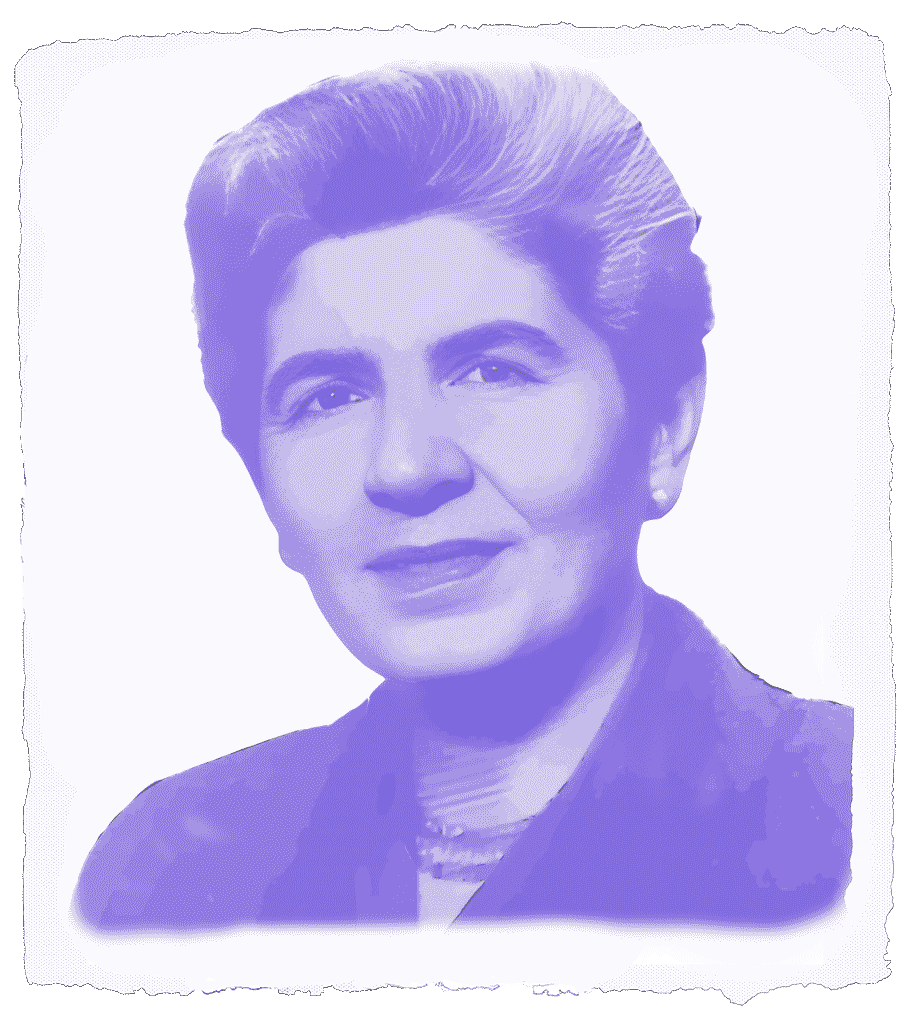
Neuropsychiatrist of the Paranormal
Neuropsychiatrist turned parapsychology researcher. It’s a career path rarely seen in the United States. But for over two decades, Shafica Karagulla (1914–1986) blazed a trail in the scientific study of paranormal phenomena.
This resource guide aims to put all relevant information about Shafica Karagulla’s contributions to fields of paranormal study in one place.
What did Shafica Karagulla do that was so influential?
- Shafica Karagulla conducted groundbreaking research on “Higher Sense Perception”.
- Shafica Karagulla investigated the human energy field and chakras.
- Shafica Karagulla helped bridge Eastern and Western approaches to consciousness.
1. Shafica Karagulla conducted groundbreaking research on “Higher Sense Perception”.
Born in Turkey in 1914, Shafica Karagulla began her career as a highly qualified neuropsychiatrist. After obtaining her medical degree and psychiatric training at prestigious institutions like the Royal Edinburgh Hospital for Mental and Nervous Disorders, she eventually found herself drawn to exploring the frontiers of human consciousness.
In the 1960s, Shafica embarked on an eight-year research project investigating what she termed “Higher Sense Perception” (HSP). This referred to paranormal abilities like telepathy, precognition, and clairvoyance. Her goal was to apply rigorous scientific methods to study these phenomena, which were often dismissed by mainstream science.
Shafica’s approach was unique for its time. Rather than working with self-proclaimed psychics, she sought out successful professionals in various fields who privately reported having paranormal experiences. These included doctors, engineers, and business executives – individuals whose credibility and observational skills could lend weight to the research.
Through extensive interviews and controlled experiments, Shafica documented numerous cases of apparent HSP. She found that many of her subjects could accurately perceive information about people and events beyond the reach of their normal senses. Some could diagnose illnesses in patients without medical examinations, while others demonstrated precognitive abilities in their professional work.
In 1967, Shafica published her findings in the book “Breakthrough to Creativity: Your Higher Sense Perception”. The work was groundbreaking for its systematic approach to studying paranormal phenomena and its focus on high-functioning individuals rather than celebrity psychics. It helped legitimize parapsychology as a field worthy of serious scientific inquiry.
2. Shafica Karagulla investigated the human energy field and chakras.
Building on her HSP research, Shafica became fascinated by the concept of the human energy field – the idea that there are subtle energy systems surrounding and interpenetrating the physical body. This led her to collaborate with clairvoyant Dora van Gelder Kunz on a long-term study of the chakras, energy centers described in many Eastern spiritual traditions.
For over two decades, Shafica and Dora worked together, combining Shafica’s medical expertise with Dora’s claimed ability to perceive subtle energies. They conducted systematic observations of patients at a major New York City medical center, attempting to correlate changes in the chakras and energy field with various physical and psychological conditions.
Their research suggested that specific patterns in the energy field could indicate predispositions to certain illnesses before they manifested physically5. They also explored how emotional and mental states affected the energy field, and how disruptions in the field might contribute to disease processes.
This work culminated in the book “The Chakras and the Human Energy Fields,” published posthumously in 1989. While controversial, the book represented one of the first attempts to bridge ancient Eastern concepts of subtle energy with modern Western medical understanding. It laid groundwork for future research into biofield science and energy medicine.
3. Shafica Karagulla helped bridge Eastern and Western approaches to consciousness.
Throughout her career, Shafica worked to integrate different paradigms for understanding human consciousness and potential. Her background in neuropsychiatry gave her a solid grounding in Western scientific methods. However, her research into HSP and subtle energies led her to explore Eastern philosophical and spiritual concepts as well.
Shafica founded the Higher Sense Perception Research Foundation to further her work. She lectured widely and wrote several books attempting to synthesize scientific and esoteric approaches to consciousness. Her efforts helped pave the way for more holistic models of human health and potential.
In the 1970s, Shafica became involved with the Theosophical Society, an organization dedicated to exploring the wisdom traditions of both East and West. She gave talks on the structure and function of the chakras, relating these ancient concepts to modern understanding of human physiology and psychology.
Shafica Karagulla’s work influenced later researchers in consciousness studies and parapsychology. Her emphasis on rigorous methodology combined with openness to non-materialist paradigms helped establish parapsychology as a legitimate field of scientific inquiry.
Read More . . .
 PARANORMAL WOMEN: A Hidden History