
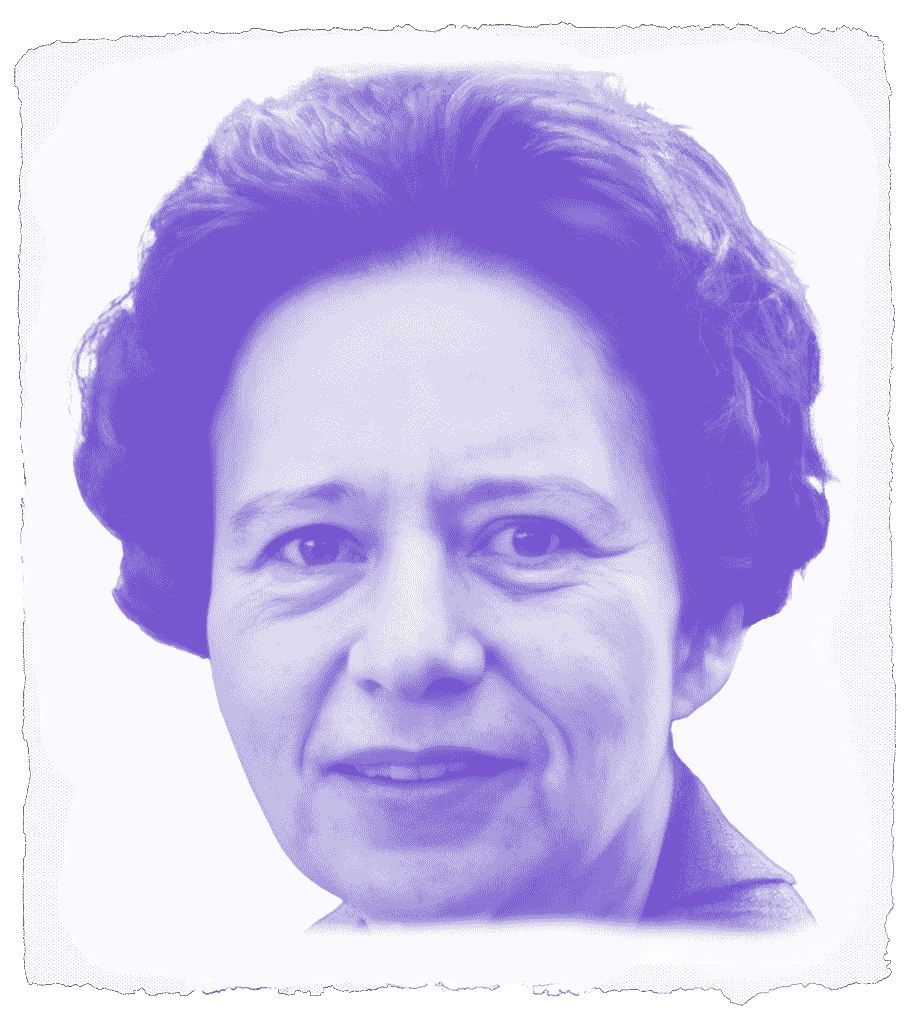
The Parapsychologist Who Caught the CIA’s Eye
Gertrude Schmeidler (1912–2009) was a trailblazing figure in the field of parapsychology, making significant contributions that continue to influence research today. Her work spanned several decades and touched on various aspects of psychic phenomena, even drawing the attention of intelligence agencies.
This updated resource guide aims to put all relevant information about Gertrude Schmeidler’s contributions to fields of paranormal study in one place.
What did Gertrude Schmeidler do that was so influential?
- Gertrude Schmeidler developed the influential “sheep-goat” theory in ESP research.
- Gertrude Schmeidler conducted groundbreaking research on out-of-body experiences (OBEs).
- Gertrude Schmeidler pioneered scientific methods for investigating hauntings.
1. Gertrude Schmeidler developed the influential “sheep-goat” theory in ESP research.
In the early 1940s, Gertrude Schmeidler began a series of experiments that would lead to one of her most significant contributions to parapsychology: the “sheep-goat” effect. This theory proposed that a person’s belief in ESP could influence their performance in ESP tests.
Gertrude categorized participants as either “sheep” (those who believed ESP was possible) or “goats” (those who rejected the possibility). Her experiments consistently showed that “sheep” scored higher on ESP tests than “goats”. This finding suggested that belief and expectation play a crucial role in psychic abilities.
The sheep-goat experiments began at Harvard in 1942, where Gertrude tested psychologists and students using a simple clairvoyance test with Zener cards. The results were striking: sheep participants averaged 5.31 correct guesses where 5.00 was expected by chance, while goats often scored below chance.
Gertrude’s work on the sheep-goat effect has been widely replicated and continues to influence parapsychological research today. It highlights the complex relationship between belief, expectation, and psi abilities.
2. Gertrude Schmeidler conducted groundbreaking research on out-of-body experiences (OBEs).
Another area where Gertrude Schmeidler made significant contributions was in the study of out-of-body experiences (OBEs). She examined numerous reports of OBEs to identify their characteristics and the conditions under which they were likely to occur.
Gertrude’s research revealed important distinctions between different types of OBEs. She found that spontaneous OBEs resulting from accidents or illnesses (often associated with near-death experiences) tended to have a deeper phenomenology and more lasting spiritual impact than self-induced OBEs.
Her work provided empirical support for OBEs as a genuine phenomenon. This support came from two main sources:
- Veridical reports in near-death accounts, where individuals reported accurate information they couldn’t have known through normal means.
- The limited but promising laboratory studies available at the time.
Gertrude’s research on OBEs helped legitimize their study within the scientific community and paved the way for further investigations into this fascinating aspect of human consciousness.
3. Gertrude Schmeidler pioneered scientific methods for investigating hauntings.
Perhaps one of Gertrude Schmeidler’s most innovative contributions was her approach to investigating haunted houses. Rather than relying solely on anecdotal evidence or subjective experiences, Gertrude developed a quantitative methodology for studying alleged hauntings.
In one notable case, Gertrude and her colleague Michaeleen Maher investigated an apartment where a young woman and her mother claimed to have repeatedly seen an apparition. Instead of conducting a typical field study, Gertrude took a more rigorous approach:
- The apartment was divided into segments.
- The witnesses were asked to indicate what kind of activity they had observed in each area.
- A group of skeptics and psychic sensitives were then invited to the apartment.
- These participants were asked to give their own impressions for each area, without knowing the witnesses’ reports.
The results were intriguing. None of the skeptics’ indications matched those given by the original witnesses. However, two of the five psychic sensitives provided impressions that matched the witnesses’ accounts to a statistically significant degree.
Gertrude also collaborated with other prominent researchers in the field, including Thelma Moss. In one study conducted by Moss in California, Gertrude analyzed data from an investigation where six sensitives toured a reportedly haunted location. Three of these sensitives provided impressions that significantly matched the original witnesses’ accounts.
This innovative approach to ghost hunting set a new standard for scientific rigor in paranormal investigations. It demonstrated that it was possible to apply quantitative methods to traditionally subjective experiences, paving the way for more credible research in this area.
Gertrude also collaborated with other prominent researchers in the field, including Thelma Moss. In one notable study conducted by Moss in California, Gertrude analyzed data from an investigation where six sensitives toured a reportedly haunted location. Three of these sensitives provided impressions that significantly matched the original witnesses’ accounts5. This collaboration further exemplifies Schmeidler’s commitment to applying rigorous quantitative methods to paranormal investigations.
The joint work with Thelma Moss on haunting cases demonstrates Gertrude’s ongoing efforts to bring scientific rigor to a traditionally subjective field. By analyzing data from multiple sensitives and comparing their impressions to witness accounts, Schmeidler and Moss were able to provide a more objective assessment of alleged paranormal phenomena. This approach helped to establish a more credible foundation for future research in the field of parapsychology.
Gertrude’s work in parapsychology was so innovative it drew attention from organizations like the CIA during the Cold War era. While not directly employed by intelligence agencies, her research on personality traits associated with ESP abilities was noted in declassified CIA documents. A CIA report mentioned that Schmeidler, from the City University of New York, had conducted “the most extensive study to date on the personality traits of persons with greater-than-average ESP ability”.
Her collaboration with renowned psychic Ingo Swann, investigating psychokinetic effects on temperature recordings, also caught the attention of intelligence researchers. This aligned with broader government-funded research into remote influencing and viewing capabilities, which eventually led to the establishment of the Stargate program at Stanford Research Institute (SRI) in the 1970s.
While Gertrude was not directly involved in these government programs, her rigorous scientific approach to parapsychology helped legitimize the field and inadvertently paved the way for intelligence agencies to consider its potential applications. This CIA interest underscores the significant impact her research had on the field of parapsychology, extending beyond academic circles to influence national security considerations during a critical period of the Cold War.
Gertrude Schmeidler’s contributions to parapsychology were vast and varied. From her groundbreaking sheep-goat theory to her pioneering work on OBEs and haunting investigations, Schmeidler helped establish parapsychology as a legitimate field of scientific inquiry. Her emphasis on rigorous methodology and quantitative analysis set a high standard for future researchers, ensuring that the study of paranormal phenomena would continue to evolve and gain credibility in the scientific community, even attracting the interest of intelligence agencies along the way.
Read More . . .
- ESP and Personality Patterns (1958)
- Extra-sensory Perception (1969)
- Via CIA: PK Changes in Recordings of Temperature (1978)
- Parapsychology and Psychology: Matches and Mismatches (1988)
 PARANORMAL WOMEN: A Hidden History