Automatic Writer and Rigorous Investigator
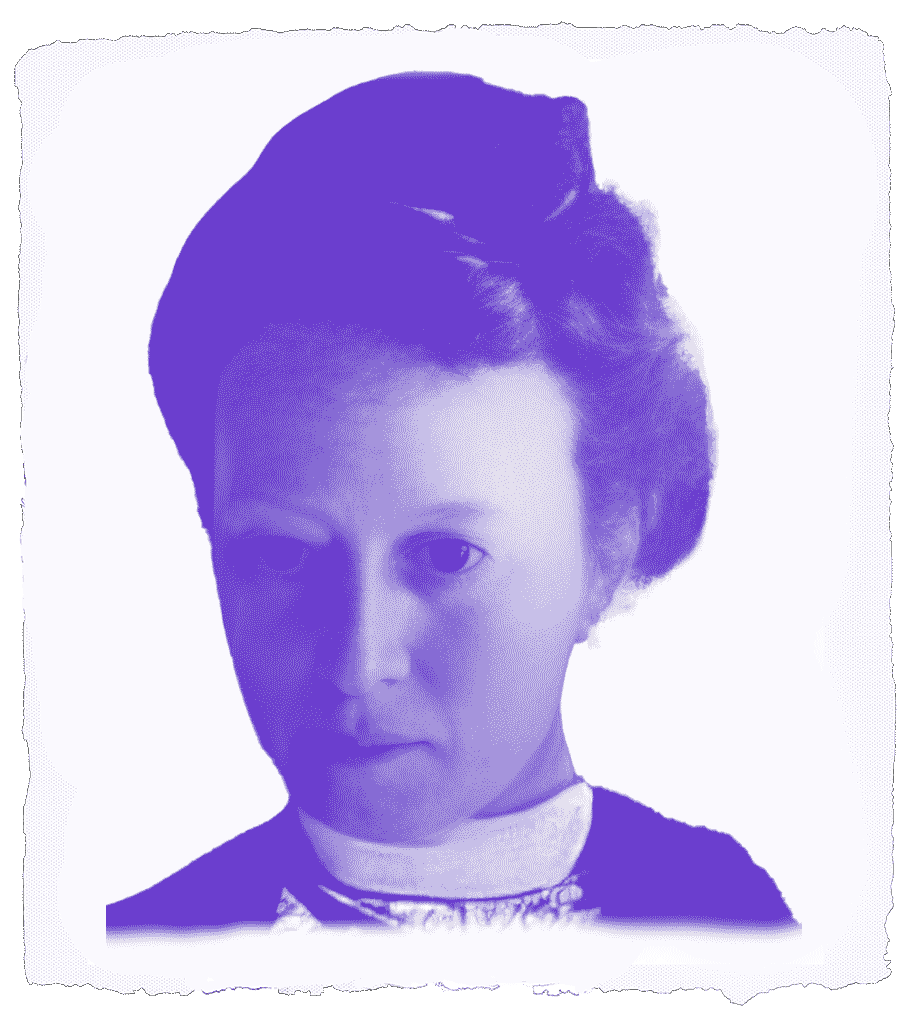
Margaret Verrall (1857-1916) was a prominent figure in early psychical research who made significant contributions to the field of parapsychology. As a classical scholar and lecturer at Newnham College, Cambridge, Verrall brought her academic rigor to the study of paranormal phenomena.
This updated resource guide aims to put all relevant information about Margaret Verrall’s contributions to fields of paranormal study in one place.
What did Margaret Verrall do that was so influential?
- Margaret Verrall conducted groundbreaking experiments in psychical research.
- Margaret Verrall played a crucial role in the cross-correspondences.
- Margaret Verrall helped establish rigorous standards for psychical research.
1. Margaret Verrall conducted groundbreaking experiments in psychical research.
Margaret began her formal psychical research in 1889 with thought-transference experiments involving her young daughter Helen. She published an account of these card-guessing tests, which included apparent instances of spontaneous telepathy between mother and child. Margaret followed this with experiments in crystal-gazing from 1889 to 1892, reporting some positive results.
In 1895, Margaret published her first major paper, a thorough report on her own card-guessing experiments conducted over several years. She meticulously tested all possible explanations besides clairvoyance, ultimately concluding there was evidence of psychic ability. This systematic approach set a standard for future parapsychological research.
Margarets’s most famous work began in 1901 when she started experimenting with automatic writing. After months of failed attempts, she suddenly found success on March 5th when she altered her pen grip. Her hand began rapidly writing in Latin, and by the end of the month she was producing meaningful passages in both Latin and English.
Margaret’s automatic writing appeared to contain messages from deceased psychical researchers like Frederic Myers. She analyzed the classical allusions in these scripts, as well as those produced by the medium Leonora Piper, finding evidence that suggested genuine communication from the deceased.
2. Margaret Verrall played a crucial role in the cross-correspondences.
Margaret’s automatic writing was instrumental in the discovery of the cross-correspondences – a complex series of apparently interconnected messages received by different mediums that seemed to originate from deceased psychical researchers. These cross-correspondences became a major focus of psychical research in the early 20th century.
The impact of Margaret’s work continued long after her death. In 1958, her son-in-law William Salter published an analysis of how literary references in her scripts convinced many that the deceased Frederic Myers was genuinely communicating.
In the 1960s and 70s, parapsychologist Guy Lambert conducted extensive investigations into the historical accuracy of information in Margaret’s automatic writing, finding evidence that appeared to support the involvement of deceased communicators.
3. Margaret Verrall helped establish rigorous standards for psychical research.
As both a researcher and psychic subject, Margaret Verrall occupied a unique position in early parapsychology. Her colleague Oliver Lodge praised her as “one of the sanest and acutest of our own investigators,” who could act as an interpreter between the psychical and physical worlds.
Margaret joined the Society for Psychical Research (SPR) in 1889, the same year it was founded with the goal of examining paranormal claims scientifically. She quickly became an active member, conducting experiments and writing reports. In 1901, she joined the SPR’s governing council, a position she held until her death in 1916.
Margaret’s meticulous approach to documenting her own psychic experiences, particularly in automatic writing, set a high standard for future researchers. Her detailed accounts provided valuable data for other investigators to analyze. Eleanor Sidgwick, another prominent SPR member, noted that Margaret’s “wise sympathy” encouraged others to cultivate and report their own psychic abilities, greatly expanding the evidence available to researchers.
Margaret Verrall’s legacy in psychical research is one of scientific rigor combined with personal psychic experience. Her work bridged the gap between academia and the paranormal, helping to establish parapsychology as a legitimate field of study. Today, her detailed records continue to provide valuable data for researchers exploring the mysteries of human consciousness and potential survival after death.
 PARANORMAL WOMEN: A Hidden History