
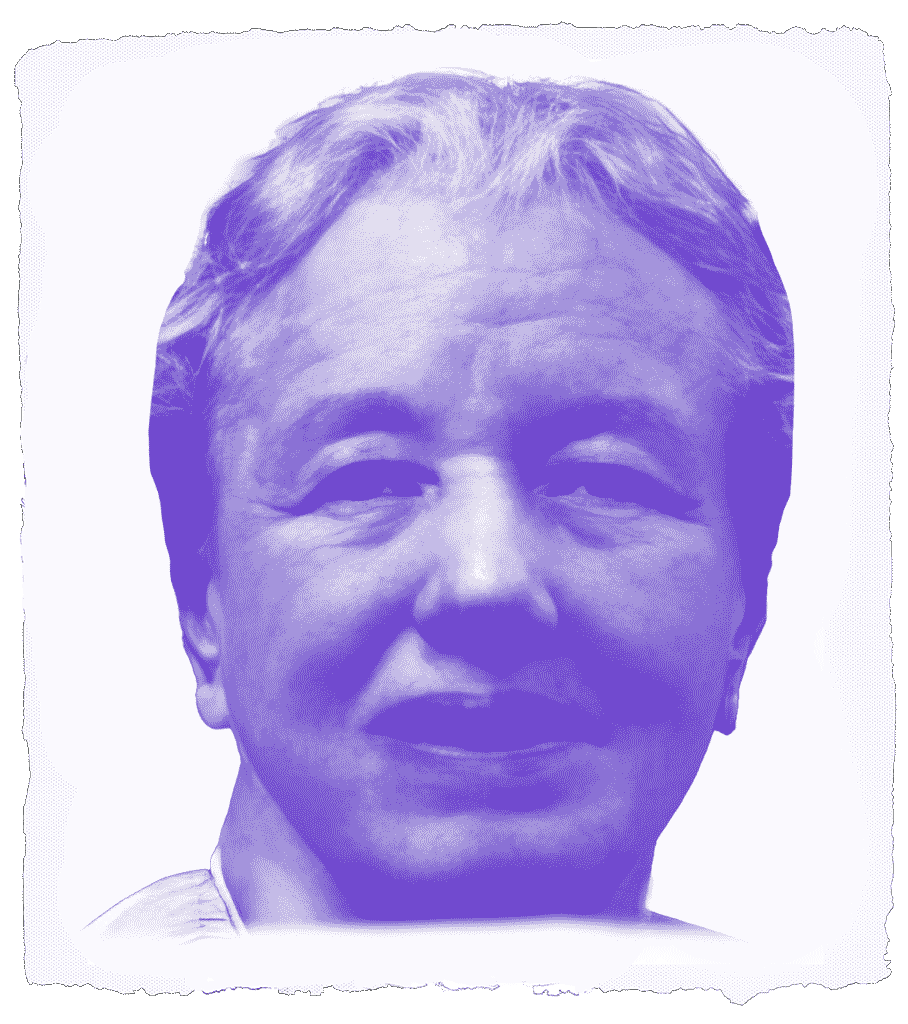
Child of the Paranormal
Helen Woollgar de Gaudrion Verrall Salter (1883-1959) was a British psychologist and psychical researcher, notable for her significant contributions to the Society for Psychical Research (SPR). Born on July 4, 1883, in Cambridge, England, she was the daughter of classical scholars Arthur and Margaret Verrall. Her mother, Margaret, was deeply involved in psychical research and was a member of the SPR.
Helen’s early exposure to psychical research began in her family home, which was a hub for séances and experiments such as crystal gazing and table turning. At the age of five, she participated in telepathy experiments with her mother.
This updated resource guide aims to put all relevant information about Helen Salter’s contributions to fields of paranormal study in one place.
What did Helen Salter do that was so influential?
- Helen Salter served as a crucial administrator for the Society for Psychical Research.
- Helen Salter contributed to groundbreaking cross-correspondence studies.
- Helen Salter bridged academic and paranormal worlds.
1. Helen Salter served as a crucial administrator for the Society for Psychical Research.
Later in life, Helen played a vital role in the operations of the Society for Psychical Research during a critical period in its history. She held the positions of Assistant Research Officer and later Research Officer for the SPR during World War I. Her administrative skills and dedication helped keep the organization running smoothly during challenging times, ensuring the continuity of paranormal research efforts.
As Research Officer, Salter would have been responsible for coordinating investigations, managing research protocols, and liaising between researchers and SPR leadership. Her work behind the scenes was essential in maintaining the SPR’s status as a leading institution in psychical research during the early 20th century.
2. Helen Salter contributed to groundbreaking cross-correspondence studies.
One of Helen’s most significant contributions to parapsychology was her involvement in the SPR’s cross-correspondence studies. These complex experiments aimed to provide evidence for survival after death by analyzing seemingly related messages received through different mediums.
Helen’s background as the daughter of Margaret Verrall, a prominent SPR member and well-known medium, likely gave her unique insights into this work. She would have been intimately familiar with the mediumistic process and able to apply both skepticism and understanding to the analysis of purported spirit communications.
The cross-correspondence studies represented some of the most sophisticated attempts to scientifically investigate the possibility of afterlife communication. Salter’s participation in this research helped advance the field’s methodologies and contributed to the ongoing debate about survival after death.
3. Helen Salter bridged academic and paranormal worlds.
As the daughter of two Cambridge scholars, Helen Salter was uniquely positioned to bridge the gap between mainstream academia and psychical research. Her father, A.W. Verrall, was a respected classicist, while her mother Margaret combined scholarly pursuits with an interest in mediumship.
Salter’s own education at Newnham College, Cambridge, gave her the intellectual foundation to approach paranormal research with academic rigor. This background allowed her to communicate effectively with skeptics and believers alike, helping to legitimize the SPR’s work in academic circles.
By maintaining high standards of evidence and critical analysis in her role at the SPR, Salter helped elevate the reputation of parapsychology as a serious field of study. Her ability to navigate both the paranormal and academic worlds was crucial in advancing psychical research during a time when it faced significant skepticism from the scientific establishment.
Helen Salter laid important groundwork for future generations of researchers and helped shape the field as we know it today. While perhaps not as well-known as some of her contemporaries, Helen’s dedication to rigorous investigation of paranormal phenomena deserves recognition. Her commitment to both scientific skepticism and open-minded inquiry serves as an inspiring example for modern paranormal researchers.
Read More . . .
- Evidence for Telepathy: The Response to a Broadcast Request for Cases (1934)
- Psychical Research: Where Do We Stand? (1945)
 PARANORMAL WOMEN: A Hidden History