
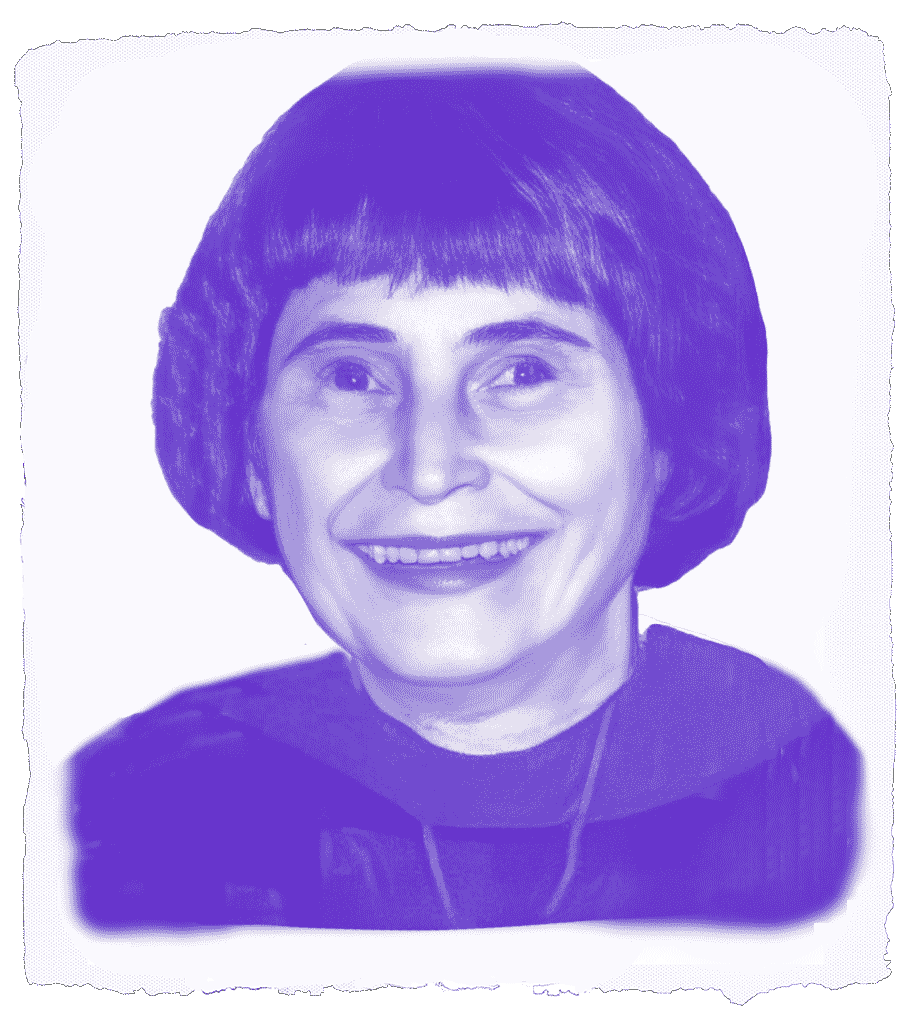
Explorer of Exceptional Human Experiences
Rhea Amelia White (1931-2007) was a prominent American parapsychologist known for her extensive research in the field. She earned her Bachelor of Arts from Pennsylvania State University in 1953. After a near-death experience during her time at Penn State, she shifted her focus from athletics to the study of exceptional human experiences.
This updated resource guide aims to put all relevant information about Rhea White’s contributions to fields of paranormal study in one place.
What did Rhea White do that was so influential?
- Rhea White coined the term “exceptional human experiences” (EHEs).
- Rhea White founded the Exceptional Human Experience Network.
- Rhea White advocated for a feminist approach to parapsychology.
1. Rhea White coined the term “exceptional human experiences” (EHEs).
White began her career as a research fellow at the Parapsychology Laboratory at Duke University in 1958. She later worked with the American Society for Psychical Research and was a charter member of the Parapsychological Association, serving as its president in 1984. In 1981, she founded the Parapsychology Sources of Information Center, creating the Psi-Line Database System, the first computerized database of literature on psychical research and parapsychology.
In the 1990s, Rhea developed the concept of exceptional human experiences (EHEs), which revolutionized the way researchers approach paranormal phenomena. EHEs encompass a wide range of spontaneous, unusual experiences that have the potential to transform an individual’s perception of themselves and the world around them.
White defined EHEs as experiences that “change the way the experiencer behaves or feels or thinks about [themself], other people, other organisms, and attitudes toward or ideas about the meaning of self, life, death, and other subjects of deep human import that the ordinary person does not have time to ponder deeply, if at all”.
This groundbreaking concept allowed researchers to study various types of paranormal experiences from a more holistic perspective, rather than focusing on individual phenomena in isolation. White’s work on EHEs encouraged a more inclusive and comprehensive approach to understanding the full spectrum of human experiences, from psychic phenomena to mystical encounters.
2. Rhea White founded the Exceptional Human Experience Network.
Building on her work with EHEs, Rhea established the Exceptional Human Experience Network (EHEN). This organization served as a hub for researchers, experiencers, and anyone interested in exploring the nature and implications of exceptional human experiences.
The EHEN provided a platform for sharing information, conducting research, and fostering collaboration among scholars and practitioners in the field. Through this network, Rhea was able to collect and analyze thousands of accounts of EHEs, creating a vast database of experiences that continues to inform research in parapsychology and related fields.
White’s work with the EHEN emphasized the importance of studying EHEs not just as isolated events, but as part of a larger pattern of human experience. She believed that by understanding these experiences, we could gain valuable insights into human consciousness and potential.
3. Rhea White advocated for a feminist approach to parapsychology.
In 1994, Rhea made a compelling case for the benefits of adopting a feminist approach to parapsychology. She argued that traditional scientific methods, which often prioritize objectivity and control, might not be the most effective way to study paranormal phenomena.
Rhea suggested that a more inclusive, experiential approach could yield valuable insights into the nature of psi and other exceptional experiences. By incorporating feminist perspectives, she believed that parapsychology could broaden its scope and develop new methodologies better suited to capturing the nuances of these elusive phenomena.
Her advocacy for a feminist approach to parapsychology challenged the field to reconsider its assumptions and methods, paving the way for more diverse and innovative research strategies. This shift in perspective has had a lasting impact on the field, encouraging researchers to explore new avenues and consider alternative viewpoints in their work.
Rhea White’s work expanded the boundaries of what was possible in the study of paranormal phenomena. Her contributions continue to inspire researchers and practitioners in the field, encouraging a more holistic and inclusive approach to understanding the full spectrum of human experiences.
Read More . . .
 PARANORMAL WOMEN: A Hidden History