Avant-Garde Film Meets the Paranormal
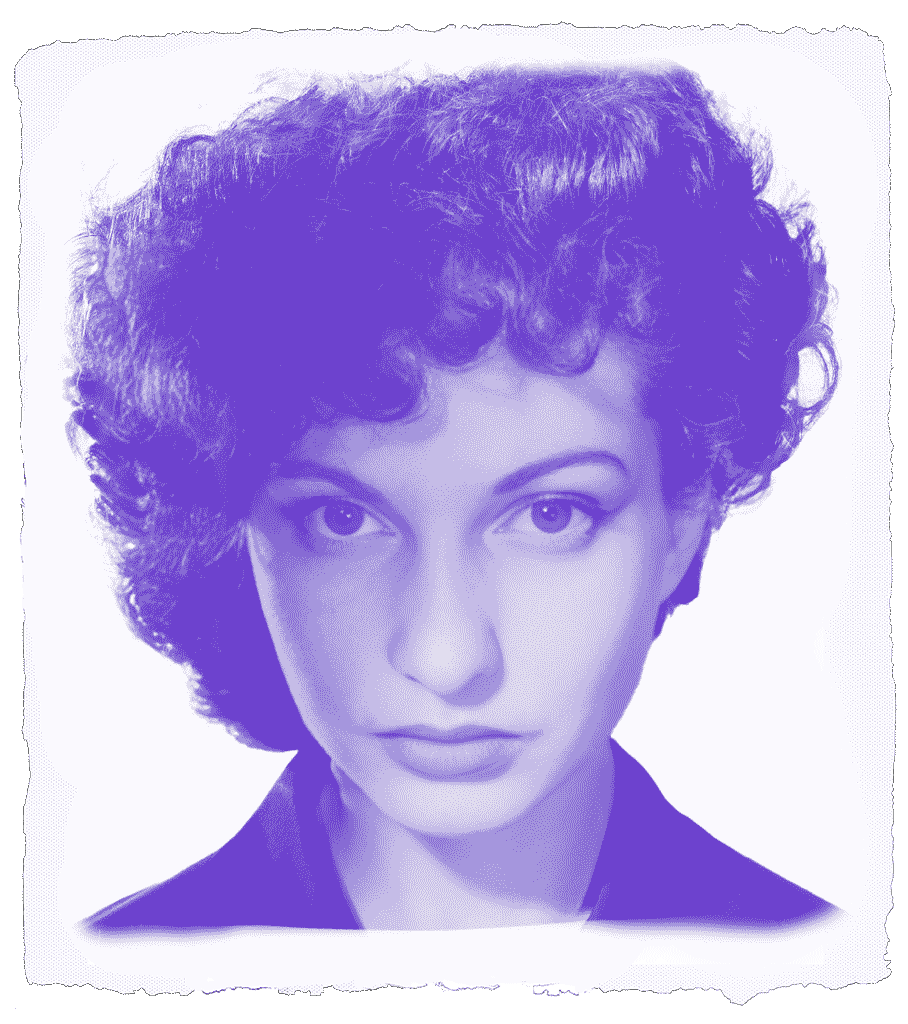
Maya Deren (1917-1961), was born Eleonora Derenkovskaya in Kiev, Ukraine. She became a pioneering avant-garde filmmaker, choreographer, and writer who made significant contributions to the field of paranormal studies. She is often referred to as the “mother” of American experimental cinema. Her work in the 1940s and 1950s significantly influenced the development of independent film in the United States. Her work continues to influence filmmakers, artists, and researchers interested in Haitian Vodou, altered states of consciousness, and spiritual experiences.
This updated resource guide aims to put all relevant information about Maya Deren’s contributions to fields of paranormal study in one place.
What did Maya Deren do that was so influential?
- Maya Deren explored altered states of consciousness through her films.
- Maya Deren immersed herself in Haitian Vodou.
- Maya Deren incorporated occult and magical concepts in her work.
1. Maya Deren explored altered states of consciousness through her films.
Maya Deren’s experimental films were revolutionary in their exploration of dream-like states, ritual, and the subconscious mind. Her most famous work, “Meshes of the Afternoon” (1943), is a surrealist short film that delves into the realm of dreams and psychological states. The film’s non-linear narrative and use of symbolism create a hypnotic, trance-like experience for viewers, mirroring altered states of consciousness often associated with paranormal phenomena.
Maya’s approach to filmmaking was deeply influenced by her interest in psychology, particularly Gestalt psychology, which she studied under Kurt Koffka. This psychological foundation informed her artistic vision, allowing her to create visual representations of inner realities and subjective experiences that challenge our perception of the physical world.
In her later works, such as “At Land” (1944) and “Ritual in Transfigured Time” (1946), Maya continued to explore themes of transformation, ritual, and the blurring of boundaries between the physical and spiritual realms. These films often featured Maya herself as the protagonist, undergoing initiatory journeys through the imaginal worlds of dreams and magick, reflecting her growing interest in occult and magical practices.
2. Maya Deren immersed herself in Haitian Vodou.
In 1947, Maya Deren’s artistic journey took a significant turn when she traveled to Haiti on a Guggenheim Fellowship to make an ethnographic film about Haitian dance. This trip would profoundly impact her life and work, as she became deeply immersed in the practice of Haitian Vodou.
Over the course of several trips to Haiti between 1947 and 1954, Maya documented Vodou rituals, filming and photographing ceremonies and participating in them herself. Her experiences led her to become initiated as a Vodou priestess, a testament to her deep respect and understanding of the religion.
Maya’s immersion in Vodou resulted in her book, Divine Horsemen: The Living Gods of Haiti, which is still considered a definitive source on the subject. In this work, she explores the concept of possession in Vodou rituals, describing how participants become vessels for divine archetypes rising from the depths of the unconscious. This perspective offers valuable insights into the nature of altered states of consciousness and spiritual experiences, which are central to many paranormal phenomena.
The footage Maya shot in Haiti, totaling an impressive 18,000 feet of film, was posthumously edited into the documentary “Divine Horsemen: The Living Gods of Haiti” (1977). This visual record provides a rare and intimate look at Vodou practices, offering researchers and enthusiasts a valuable resource for studying trance states and spiritual manifestations.
3. Maya Deren incorporated occult and magical concepts in her work.
Throughout her career, Maya Deren demonstrated a profound interest in magic, the occult, and supernatural phenomena, which she incorporated into both her artistic creations and theoretical writings. Her early exposure to Kabbalistic writings and her longstanding interest in the occult informed her approach to filmmaking and her understanding of “inner realities”.
Maya’s films often contain deliberate references to magical and occult concepts. For example, in “At Land,” anthropologist Margaret Mead revealed that several physical gestures in the film are based on signifiers of witchcraft and occult influences. This intentional incorporation of esoteric symbolism adds layers of meaning to Maya’s work, inviting viewers to explore the intersection of art and the paranormal.
In her theoretical writings, such as An Anagram of Ideas on Art, Form, and Film, Maya articulated her views on the relationship between art, ritual, and altered states of consciousness. She emphasized the importance of de-centering the self and ego, a concept that resonates with many spiritual and paranormal practices that seek to transcend ordinary consciousness.
Maya’s exploration of the magical woman archetype in her films, particularly in “Meshes of the Afternoon,” “At Land,” and “Ritual in Transfigured Time,” reflects her growing interest in witchcraft and feminine power. These portrayals offer a unique perspective on the role of women in magical and paranormal practices, challenging conventional narratives and inspiring future generations of artists and researchers.
Maya Deren’s immersion in Haitian Vodou, exploration of altered states of consciousness, and incorporation of occult concepts into her work warrant further study. There may be a lot left to decipher in her artistic attempts to better understand the mysteries of consciousness and the unseen world.
 PARANORMAL WOMEN: A Hidden History