
A Novelist turned Psychical Researcher
Margaret Deland (1857–1945) was an American novelist, poet, and short story writer known for her contributions to literary realism. Beyond her literary pursuits, Margaret and her husband, Lorin, held a profound interest in the paranormal.
Margaret began reading the research reports of scholars and scientists involved with psychical research, including the Harvard professor and the founder of the American Psychological Association, William James. These readings led Margaret to believe as she confided in Lorin, that “the hypothesis of survival is thinkable.”
This updated resource guide aims to put all relevant information about Margaret Deland’s contributions to fields of paranormal study in one place.
What did Margaret Deland do that was so influential?
- Margaret Deland conducted her own experiments in psychical research.
- Margaret Deland published articles documenting her paranormal experiences.
- Margaret Deland was an advocate for paranormal research.
1. Margaret Deland conducted her own experiments in psychical research.
Margaret’s interest in the paranormal intensified following the death of her husband, Lorin, in 1917. Margaret honored her husband Lorin’s long-standing commitment public service by lending aid in war-torn Europe. While volunteering in France in 1918, to keep her spirits up (No pun intended.), Mary consulted an Ouija board regularly.
On her return to the U.S., Mary began conducting experiments in psychical research. Many took place at her summer estate in Kennebunkport, Maine. These experiments included séances, telepathy tests, and investigations alleged hauntings, mirroring the work of prominent psychical researchers of her time.
Her approach to paranormal investigation was methodical and scientific. She pledged to maintain an open and receptive mind during séances, concentrating fully on the medium’s performance. This level of dedication often left Margaret feeling as exhausted as the medium after each session.
Margaret was skeptical, but she couldn’t explain away those nuggets of verifiable truth that often sprung from the mouths of mediums. These seemingly trivial details so often referenced during seances became profound when they were revealed as the stuff of deeply personal interactions, shared experiences, and inside jokes between sitters and the spirits of their loved ones.
Personally Margaret was even more amazed by one famous medium’s ability to spy on the living. During a sitting with Leonora Piper, she inquired about what her mother was doing at that very moment. Through her trance, Leonora apparently remote-viewed Margaret’s mother, miles away in her Boston home, sitting on the couch, shaking a box of buttons, and carefully selecting three to sew on a garment. By phone, Margaret later verified every detail with her mother.
On another occasion, Margaret devised a complicated long-distance experiment involving automatic writing, the practice of allowing a spirit to take over a medium’s pen. While a friend of hers, identified only as Mrs. H. sat for an automatic writing session with medium Leonora Piper in Boston, Margaret and another friend worked the Ouija board inside her home right her summer home. Unbeknownst to Mrs. H. and Leonora, the plan was to use the spirit of the Ouija board to interrupt the session and deliver an unrelated message.
The specific objective was to coax the spirit controlling Leonora’s hand to write something about President George Washington as it was scribbling a message for Mrs. H. from the dearly departed. The only problem, noted the spirit of the Ouija board, was that the ancient clergyman control spirit who had taken possession of Leonora didn’t know of George Washington.
When Mrs. H. returned with her written message, Margaret noticed amidst the scrawl one non sequitur line stuck out because it didn’t have anything to do with the content and was written in a much bolder hand. It simply read, “There’s someone here named George.” Although this wasn’t definitive proof for Margaret that her experiment was successful, it was a promising development.
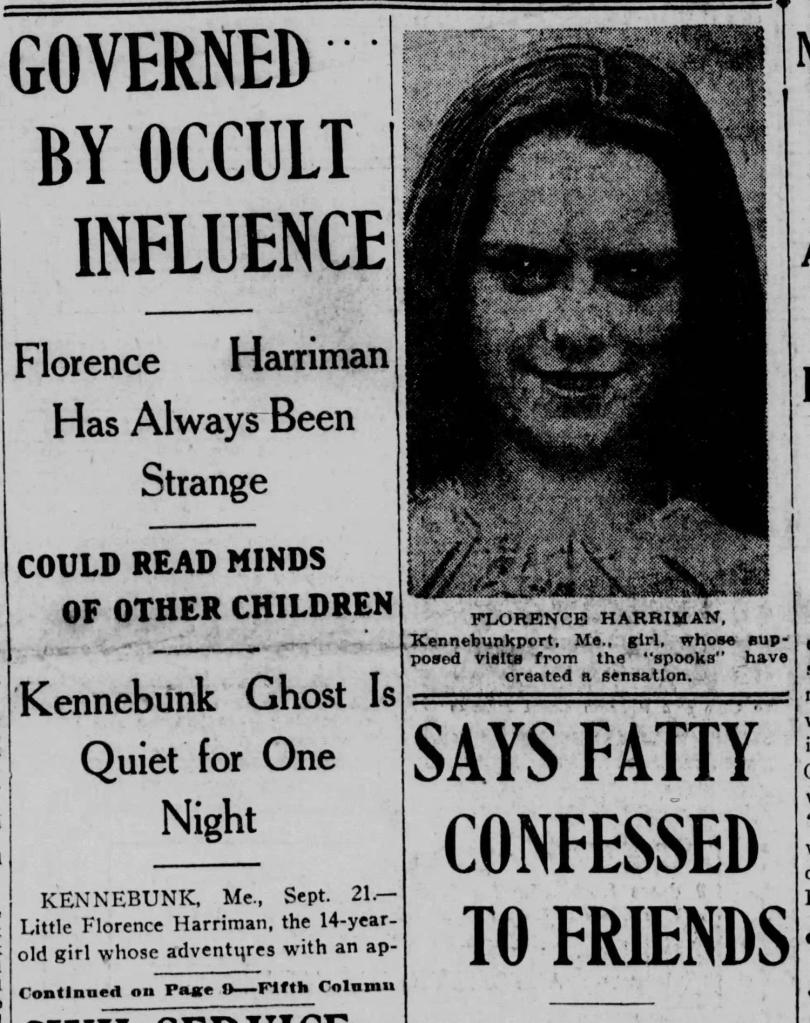
Although we don’t know the extent of Margaret’s paranormal investigations, tantalizing newspaper mentions of her presence at the scene of poltergeist disturbances in Kennebunkport, Maine in 1921 suggest she had a keen interest. Margaret, and a possible Scooby Gang of other local authors and artists including Booth Tarkington and Abbott Graves, showed up to look in on the poltergeist agent Florence Harriman and her family.
2. Margaret Deland published articles documenting her paranormal experiences.
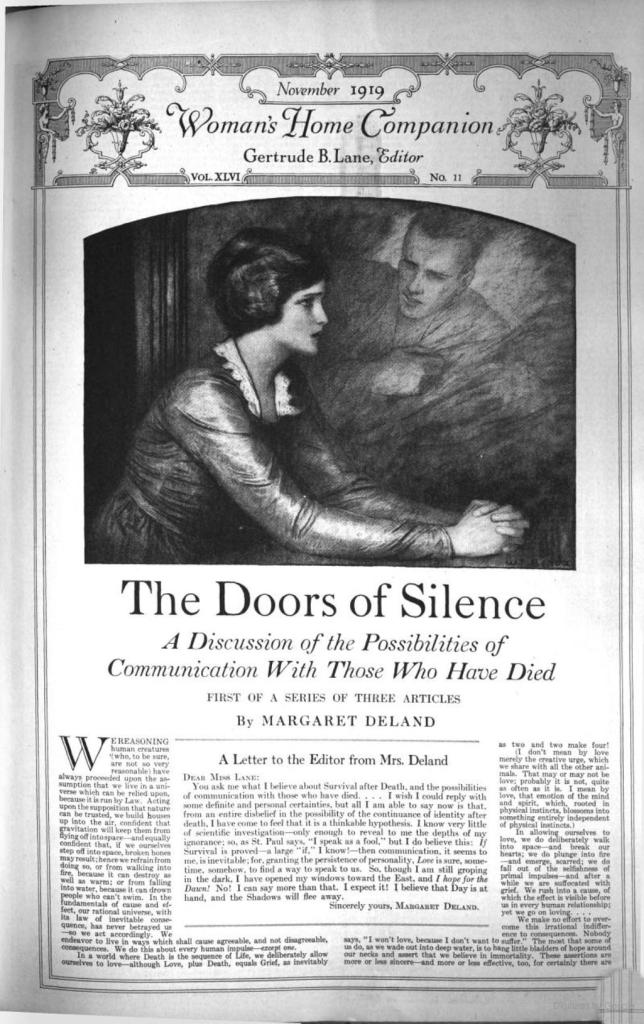
Margaret’s personal research as well as her work for the American Society for Psychical Research and the Boston Society found expression in 1919. In that year, she authored a series of articles entitled “The Doors of Silence” for the magazine Woman’s Home Companion, exploring the study of after-death communication. These articles provided a platform for Margaret to share her insights and experiences with a wider audience, contributing to the growing public interest in Spiritualism during the 1920s.
3. Margaret Deland was an advocate for paranormal research.
In November 1926, Margaret participated in a symposium on psychical research at Clark College in Worcester, Massachusetts organized by Harry Houdini and resident professors. (Unfortunately, Harry Houdini did not attend the symposium . . . at least in the flesh. He died unexpectedly on October 31, 1926.)
Speakers for and against psychical belief took to the stage. Margaret gave a presentation that included personal research findings and historical evidence to advocate for further funding and study of paranormal phenomena. Her presence at such academic events helped elevate the discourse surrounding psychical research.
Margaret Deland’s relevance to the paranormal field is multifaceted. Through her personal experiments, written works, and advocacy, she played a crucial role in advancing the study and public understanding of psychic phenomena.
Read More . . .
- The Doors of Silence, part 1 (November 1919)
- The Doors of Silence, part 2 (December 1919)
- The Doors of Silence, part 3 (January 1920)
- The Doors of Silence, part 4 (February 1920)
 PARANORMAL WOMEN: A Hidden History