
A Learned Advocate for Psi Research
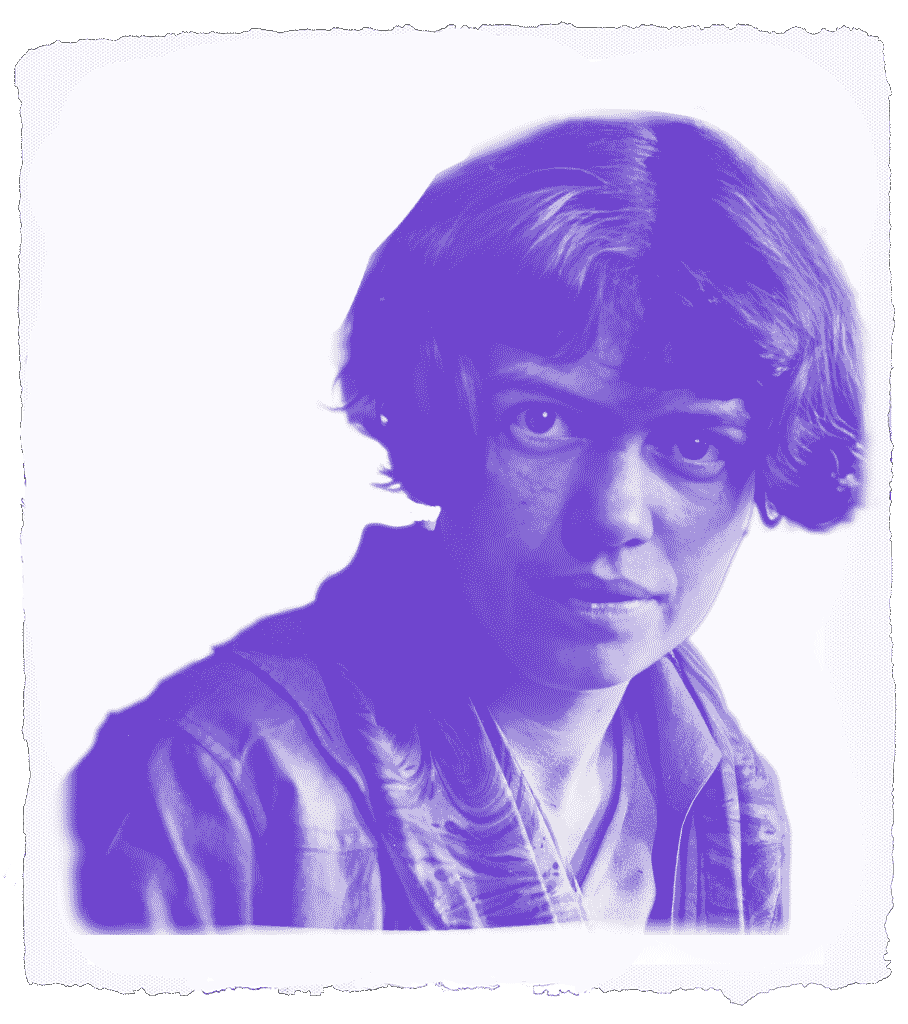
Margaret Mead (1901-1978) one of the most influential American anthropologists of the 20th century, made significant contributions to the field of paranormal studies through her groundbreaking research and open-minded approach to unexplained phenomena.
This updated resource guide aims to put all relevant information about Margaret Mead’s contributions to fields of paranormal study in one place.
What did Margaret Mead do that was so influential?
- Margaret Mead studied the supernatural beliefs of indigenous cultures.
- Margaret Mead advocated for scientific investigation of psychic phenomena.
- Margaret Mead explored the relationship between psychedelics and psychic experiences.
1. Margaret Mead studied the supernatural beliefs of indigenous cultures.
Margaret conducted extensive fieldwork in various cultures, particularly in Oceania. During her studies, she encountered and documented supernatural beliefs and practices that were integral to these societies.
In her research on the island of Manus in Papua New Guinea, Margaret observed a culture where the supernatural permeated everyday life. Interestingly, she found that children in this society showed little interest in supernatural themes in their artwork, instead focusing on realistic depictions of their surroundings. This discovery challenged prevailing notions about the universality of childlike thought and highlighted the cultural influences on supernatural beliefs.
Margaret’s work with indigenous cultures provided valuable insights into how different societies perceive and interact with the supernatural. Her research demonstrated that mystical beliefs are deeply rooted in cultural contexts, offering a fresh perspective on paranormal phenomena.
2. Margaret Mead advocated for scientific investigation of psychic phenomena.
Throughout her career, Margaret maintained an open mind towards psychic phenomena and advocated for their scientific investigation. She believed that these unexplained occurrences should be studied using rigorous scientific methods rather than dismissed outright.
Margaret even took part in parapsychological laboratory experiments with parapsychologist Gardner Murphy, using those iconic Zener cards, was a trustee of the American Society for Psychical Research also serving on its research committee. She also was a supporter of the Parapsychological Association.
In 1969, Mead played a crucial role in legitimizing parapsychology as a field of study. She passionately advocated for the American Association for the Advancement of Science (AAAS) to allow the Parapsychological Association (PA) to become a member organization. This move significantly elevated the status of parapsychology within the scientific community.
Mead’s support for parapsychology extended beyond institutional recognition. She argued that psi research should be integrated into normal anthropological studies rather than treated as a separate discipline. In her view, terms like “extrasensory” and “paranormal” were problematic as they suggested forces beyond the reach of science. Instead, she proposed using the term “other-sensory” to describe these phenomena.
3. Margaret Mead explored the relationship between psychedelics and psychic experiences.
Margaret Mead was intrigued by the potential connection between psychedelic substances and psychic experiences. While her plans to study the effects of psychedelics on psychic phenomena were largely thwarted by the criminalization of these substances, her interest in this area was well-documented.
Mead’s fascination with altered states of consciousness and their potential to enhance psychic abilities aligned with the broader counterculture movement of the 1960s and 1970s. She recognized the value of exploring non-ordinary states of consciousness as a means of understanding human potential and expanding our knowledge of reality.
Although Mead was unable to conduct extensive research in this area due to legal restrictions, her interest in the topic helped pave the way for future studies on the relationship between psychedelics and paranormal experiences.
Margaret Mead’s contributions to the field of paranormal studies, while often overshadowed by her more mainstream anthropological work, were significant and far-reaching. Her open-minded approach to unexplained phenomena and her insistence on applying rigorous scientific methods to their study continue to inspire researchers in the field today.
Read More . . .
- “An Anthropological Approach to Different Types of Communication and the Importance of Differences in Human Temperaments” in Extrasensory Ecology: Parapsychology and Anthropology (1977)
- “The Occult: On the Edge of the Unknown” in Magic, Witchcraft, and Religion: An Anthropological Study of the Supernatural (1989)
 PARANORMAL WOMEN: A Hidden History