
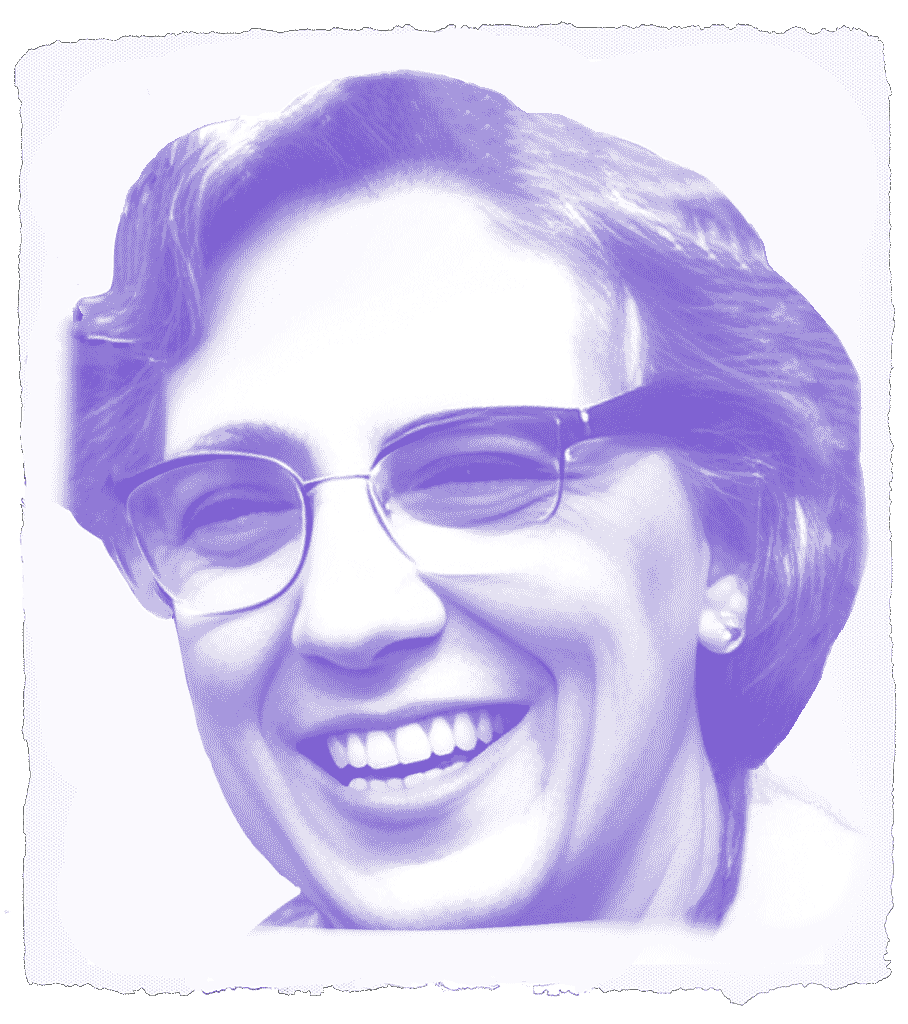
Guardian and Promoter of Her Husband’s Work
While Lois Barclay Murphy (1902–2003) is celebrated for revolutionizing child psychology—emphasizing empathy, resilience, and holistic development—her lesser-known contributions to the paranormal field reveal a fascinating interdisciplinary legacy. Through collaboration, advocacy, and methodological innovation, Lois’s work intersected with psychical research in ways that deserve recognition.
This updated resource guide aims to put all relevant information about Lois Barclay Murphy’s contributions to fields of paranormal study in one place.
What did Lois Barclay Murphy do that was so influential?
- Lois Barclay Murphy formed an intellectual partnership with her husband Gardner Murphy.
- Lois Barclay Murphy preserved and promoted her husband’s parapsychological research.
- Lois Barclay Murphy exerted a methodological influence on psi research.
1. Lois Barclay Murphy formed an intellectual partnership with her husband Gardner Murphy.
Lois’s marriage to Gardner Murphy, a towering figure in both psychology and parapsychology, forged a dynamic intellectual partnership. Though Lois focused on the psychology of child development, her work often complemented Gardner’s paranormal research. Together, they explored how psychological principles could inform parapsychology, particularly in understanding the conditions that foster psychic phenomena.
Gardner emphasized that interpersonal relationships between experimenters and subjects significantly influenced psi test outcomes, a view that resonated with Lois’s studies on empathy and social dynamics in children. Their shared belief that normal and paranormal psychology were interconnected laid groundwork for interdisciplinary dialogue—even if Lois’s direct contributions remained implicit.
2. Lois Barclay Murphy preserved and promoted her husband’s parapsychological research.
After Gardner’s death in 1979, Lois dedicated herself to safeguarding his legacy. She compiled his papers on psi phenomena, survival research, and mediumship into There Is More Beyond: Selected Papers of Gardner Murphy (1989) and authored Gardner Murphy: Integrating, Expanding, and Humanizing Psychology (1990). These works ensured that his paranormal investigations—often marginalized by mainstream science—remained accessible to future researchers.
Her efforts highlighted Gardner’s arguments for open-minded scientific inquiry, such as his insistence that telepathy and clairvoyance were empirically valid. By contextualizing his paranormal work within broader psychological frameworks, Lois challenged the stigma surrounding psychical research.
3. Lois Barclay Murphy exerted a methodological influence on psi research.
Lois’s groundbreaking studies on childhood coping mechanisms and projective techniques subtly influenced paranormal research methodologies. Her emphasis on observing individuals in naturalistic, emotionally engaged settings paralleled Gardner’s advocacy for studying psi in contexts that mirrored real-life spontaneity—rather than sterile lab conditions.
For example, her use of unstructured play to assess personality aligned with Gardner’s belief that psi thrived in relaxed, imaginative states. While Lois never directly studied the paranormal, her child development frameworks provided tools to explore how psychological traits (e.g., dissociation, creativity) might correlate with psychic abilities—a hypothesis Gardner later tested.
Lois’s legacy in paranormal research is one of quiet stewardship. By bridging developmental psychology and psychical inquiry—and preserving her husband’s work—she helped normalize dialogue about phenomena that mainstream science often dismiss. In an era increasingly open to interdisciplinary frontiers, her contributions remind us that understanding the paranormal begins with understanding the human mind.
Read More . . .
 PARANORMAL WOMEN: A Hidden History