
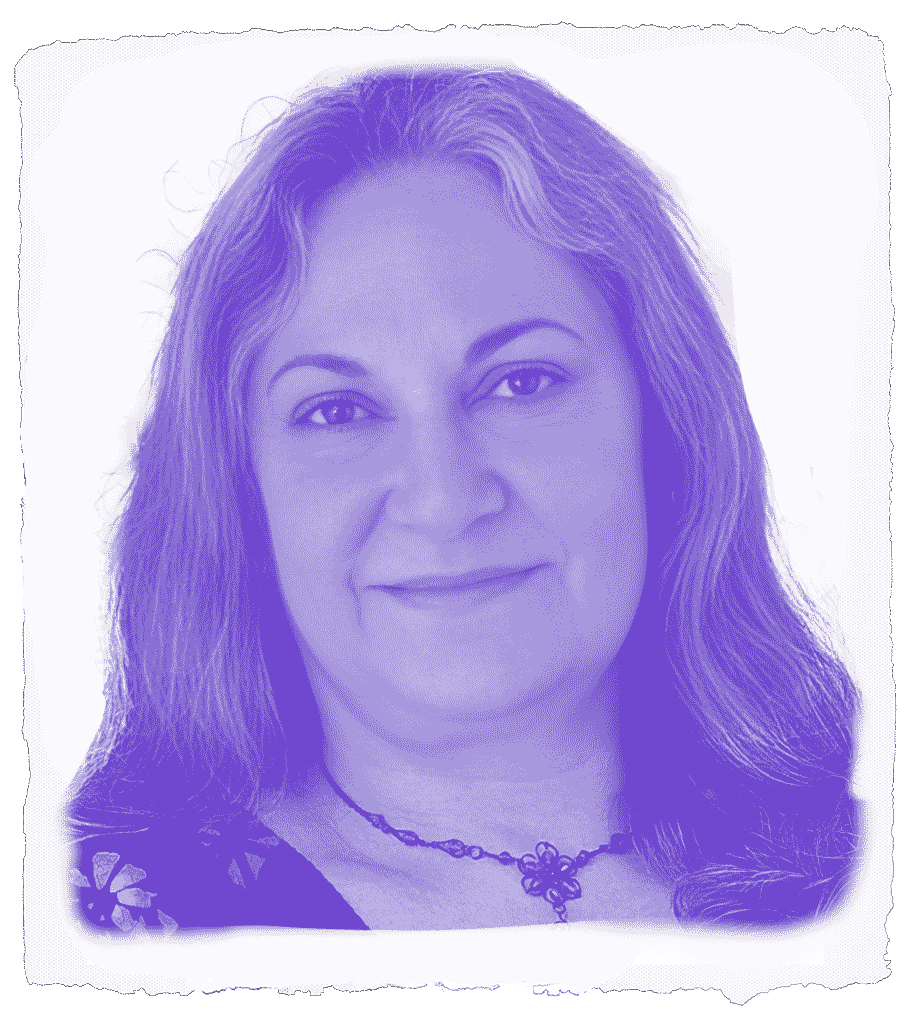
Manager of the PEAR Lab
If you’ve ever wondered whether love could influence a random number generator or if your thoughts might nudge the universe’s chaos into order, you might be pleased to know that someone has actually attempted to find out. Brenda J. Dunne (1944–2022) spent her life chasing those very questions. She was a prominent figure in the field of parapsychology, best known for her role as the laboratory manager of the Princeton Engineering Anomalies Research (PEAR) lab from its inception in 1979 until its closure in 2007.
Brenda collaborated closely with Robert G. Jahn, the founder of PEAR, to explore phenomena such as psychokinesis and remote viewing. Developmental psychologist turned consciousness researcher, Brenda co-ran this clandestine corner of Ivy League academia where stuffed frogs, falling pinballs, and human intention collided in experiments that redefined what science dares to call “real.”
Brenda wasn’t just a lab manager in a cardigan. She was the heart of PEAR, the one who turned cold engineering equipment into something resembling a cozy parlor for psychic exploration. While her partner, physicist Robert, designed machines to measure the impossible, Brenda infused the work with warmth, intuition, and a radical openness to the unseen. Together, they built the largest dataset ever collected on mind-over-matter phenomena—and quietly upended assumptions about consciousness itself.
Beyond her work at PEAR, Brenda co-authored several significant texts on consciousness and its interaction with the physical world, including Margins of Reality: The Role of Consciousness in the Physical World with Robert. She also served as the president and treasurer of the International Consciousness Research Laboratories (ICRL), an organization dedicated to the study of consciousness-related phenomena.
This updated resource guide aims to put all relevant information about Brenda Dunne’s contributions to fields of paranormal study in one place.
What did Brenda Dunne do that was so influential?
- Brenda Dunne proved ordinary people can bend reality.
- Brenda Dunne was an early explorer of Remote Viewing.
- Brenda Dunne framed consciousness as the fundamental force in the Universe.
1. Brenda Dunne proved ordinary people can bend reality.
Most labs studying psychokinesis (PK) in the 1970s focused on “gifted” subjects—supposed psychics who could allegedly bend spoons or stop clocks. Brenda flipped the script. At PEAR, she and Robert invited everyday undergrads, professors, and even skeptical engineers to try influencing machines called random event generators (REGs). These devices, akin to atomic-level coin flippers, produced binary outputs (0s and 1s) governed by quantum noise. The task? Use intention to skew the results toward more 1s (“high”) or 0s (“low”).
Over 2.5 million trials, Brenda’s teams found a small but undeniable effect: participants consistently shifted the machines’ outputs in their intended direction, defying chance odds by up to 1 in 1,000. The kicker? Success didn’t require psychic prowess. Brenda believed environmental resonance mattered more than talent. She draped the lab in tapestries, scattered plush toys, and perched a rubber frog on one REG “to make the machines more alive”.
“It’s human nature to pray, to hope, to desire,” Brenda told Wired in 1995. “Where does this fit into a scientific worldview?” Her answer: consciousness isn’t a passive observer—it’s a participant, tweaking reality’s probabilities through sheer focus. Later studies even showed gender differences: men nudged machines more directly, while women’s influence ran deeper.
2. Brenda Dunne was an early explorer of Remote Viewing.
Before the CIA’s Stargate program made headlines, Brenda was running her own “remote perception” trials. While still a student at the University of Mundelein, just outside Chicago, Dunne had successfully replicated the original Stanford Research Institute Studies on remote viewing.
Here’s how it worked:
- A “percipient” sat in the lab, scribbling impressions of a double-blinded location.
- An “agent” (often Dunne herself) traveled to the randomly selected site—sometimes hours after the percipient’s description was recorded to assess the accuracy of the percipient’s description.
In one trial, a participant sketched “a stone bridge over water” and noted “the smell of diesel.” The next day, Brenda drove to an industrial canal with a crumbling brick overpass—a match so precise it left Robert speechless. Over 650 trials, results showed statistically significant matches, whether the agent was 5 miles or 5,000 miles away. Distance and time, Brenda argued, were irrelevant: consciousness operated beyond spacetime’s “local” limits.
3. Brenda Dunne framed consciousness as the fundamental force in the Universe.
Brenda’s boldest legacy lies in her theoretical work. With Robert, she co-authored Margins of Reality in 1987. The book is a dense, metaphor-rich tome arguing that consciousness isn’t an evolutionary accident—it’s a fundamental force, as integral to physics as gravity.
Their model borrowed quantum principles:
- Uncertainty: Consciousness “collapses” probabilistic systems (like REGs) through intention.
- Non-locality: Mind and matter share a “resonance” unbound by distance.
- Entanglement: Emotional bonds (like love) reduce entropy, subtly organizing chaos.
Dunne compared reality to a “quantum pinball machine,” where human intention nudges randomness into patterns. She even speculated that medical anomalies—spontaneous remissions, placebo effects—might stem from this mind-matter interplay.
Though mainstream science ignored PEAR’s work, Brenda never wavered. “We’re witnessing a new science,” she insisted. After retiring, Brenda relocated PEAR’s equipment to a UK estate, ensuring the research would continue, outliving Princeton’s skepticism.
Brenda died in 2022, but her ideas still ripple through labs studying quantum biology, meditation’s neural effects, and collective intention experiments (like the Global Consciousness Project). She proved that rigor and mysticism aren’t opposites—and that sometimes, to find truth, you need a cozy lab stocked with teddy bears and toy frogs.
As Brenda once mused: “Do we dare theorize that love has a palpable influence on random noise? I don’t know. I would be willing at least to raise the question.”
 PARANORMAL WOMEN: A Hidden History