
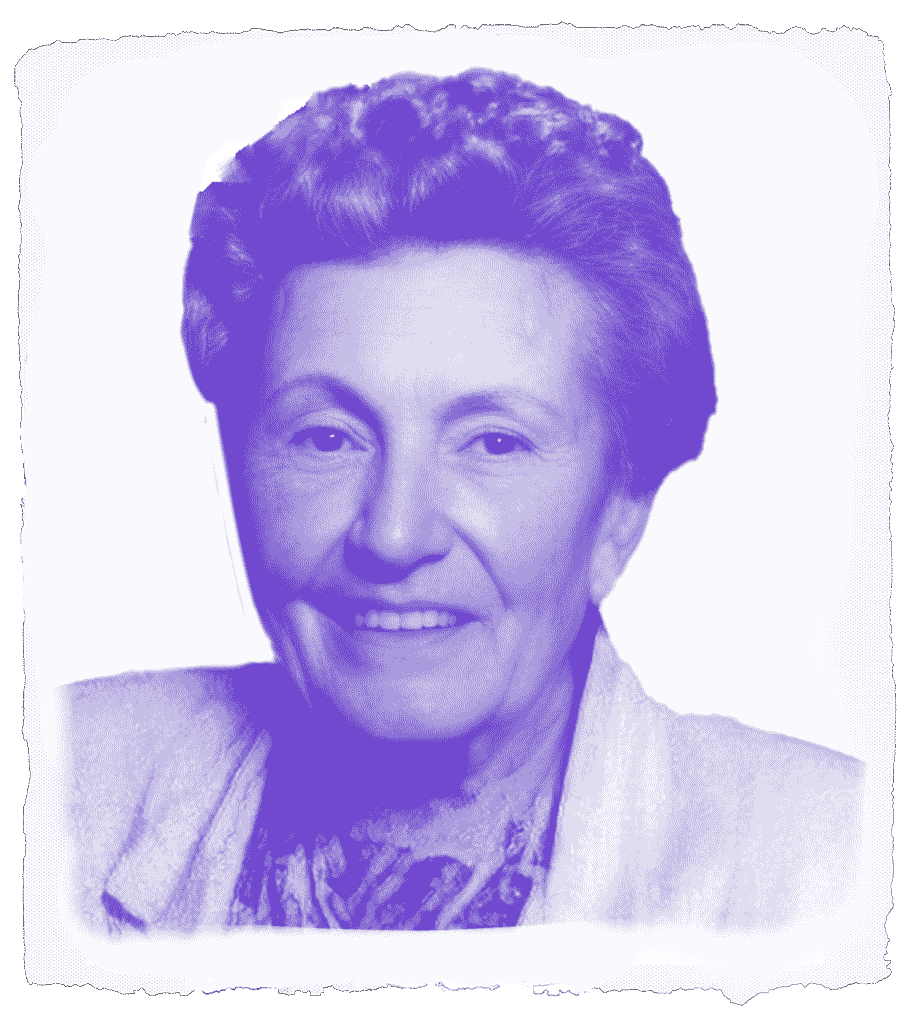
The Steward of a Parapsychology Legacy
Eileen Coly (1916–2013) may not be a household name in the paranormal community, but her behind-the-scenes work shaped the field of parapsychology for decades. As the daughter of famed medium Eileen J. Garrett and president of the Parapsychology Foundation (PF) for over 30 years, Eileen Coly operated at the intersection of scientific rigor and spiritual inquiry. While her mother’s flamboyant mediumship often stole the spotlight, Eileen Coly’s quiet dedication to institutional stability, academic collaboration, and archival preservation ensured that parapsychology survived its most turbulent eras.
This updated resource guide aims to put all relevant information about Eileen Coly’s contributions to fields of paranormal study in one place.
What did Eileen Coly do that was so influential?
- Eileen Coly shepherded the Parapsychology Foundation through a changing era.
- Eileen Coly helped bridge the gap between Academia and the Paranormal.
- Eileen Coly helped preserve the field’s hidden history.
1. Eileen Coly shepherded the Parapsychology Foundation through a changing era.
When Eileen Coly assumed leadership of the Parapsychology Foundation in 1971, she inherited an organization at a crossroads. Founded in 1951 by her mother and Congresswoman Frances Bolton, the PF had spent two decades funding research into extrasensory perception, psychokinesis, and survival after death. But her mother’s death in 1970 left a void—not just in leadership, but in the charismatic force that had attracted scientists and donors alike.
Eileen’s tenure, which lasted until 2003, transformed the PF from a personality-driven project into a structured institution. Unlike her mother, who blended mediumship with entrepreneurship, Eileen Coly focused on administrative pragmatism. She navigated the 1970s—a decade when parapsychology faced heightened skepticism from mainstream science—by doubling down on the PF’s core mission: to support “objective and analytical” research. Under her leadership, the foundation funded groundbreaking studies, including the work of Montague Ullman on dream telepathy and the Ganzfeld experiments that later became a cornerstone of ESP research.
Eileen’s approach wasn’t without friction. The rise of the New Age movement in the 1980s, with its emphasis on commercialization and unverified claims, clashed with her commitment to scientific rigor. As she later remarked, “Creative whirlwinds are exciting but messy to clean up after”. By maintaining strict grant criteria and prioritizing peer-reviewed research, she insulated the PF from the pseudoscientific trends that plagued the field.
2. Eileen Coly helped bridge the gap between Academia and the Paranormal.
Eileen recognized that parapsychology’s credibility hinged on its integration into academia. To this end, she expanded the PF’s educational programs, offering scholarships to graduate students and early-career researchers. These grants enabled pioneers like Dean Radin and Julie Milton to pursue studies that might otherwise have been dismissed as fringe.
One of Eileen’s most impactful initiatives was the PF’s conference series, which brought together psychologists, physicists, and anthropologists to debate paranormal phenomena. The 1981 conference on “Research in Parapsychology” featured future Nobel laureate Brian Josephson, whose interest in quantum mechanics and consciousness drew mainstream attention to the field. Eileen also championed interdisciplinary dialogue, publishing conference proceedings that remain foundational texts.
Eileen’s editorial work extended to the PF’s literary output. She oversaw the release of monographs like The Mind Possessed (1972), which explored possession states through clinical and cultural lenses, and Psi and Psychiatry (1975), co-authored by psychiatrists and parapsychologists. By framing paranormal research within established scientific disciplines, Eileen lent it legitimacy—a strategy that continues to influence parapsychology today. Some of Eileen’s correspondence was even of interest to the CIA and, for unknown reasons, ended up in their archives.
3. Eileen Coly helped preserve the field’s hidden history.
Eileen understood that parapsychology’s future depended on preserving its past. Under her direction, the PF amassed one of the world’s largest collections of paranormal literature: over 12,000 volumes, including rare manuscripts on early Spiritualism, annotated séance records, and unpublished field notes from investigators like Nandor Fodor and Hans Holzer. This treasure trove, now housed at the University of Maryland, Baltimore County (UMBC), offers scholars firsthand accounts of phenomena that defy conventional explanation.
The collection’s crown jewels include:
- The R101 Airship Files: Transcripts of Garrett’s 1930 trance communications about the British airship disaster, later verified by survivor testimonies.
- Bindelof Séance Records: Detailed notes on the controversial 1920s mediumship of Carlos Mirabelli, whose levitation claims remain unexplained.
- Garrett’s Personal Archives: Scrapbooks and correspondence revealing her private struggles to reconcile mediumship with scientific scrutiny.
Eileen didn’t just stockpile these materials. She made them accessible. In the 1990s, she launched a cataloging project that digitized rare journals like Psychic Research and Proceedings of the Society for Psychical Research, ensuring their survival into the digital age. For researchers, this archive is akin to a Rosetta Stone—a key to decoding paranormal history.
Eileen brought her mother’s vision to life, fostering academic partnerships, and safeguarding fragile histories. This realization of a dream gave parapsychology the tools it needed to outlive its skeptics. As current PF president Lisette Coly (her daughter) notes, “Without her steady hand, we’d have lost decades of knowledge to obscurity”. In an era where the paranormal oscillates between TikTok trends and lab-grade scrutiny, Eileen Coly’s model—rigorous, collaborative, and rooted in evidence—remains essential.
 PARANORMAL WOMEN: A Hidden History