

The Jewish Refugee Who Became a Skeptical Voice in Parapsychology
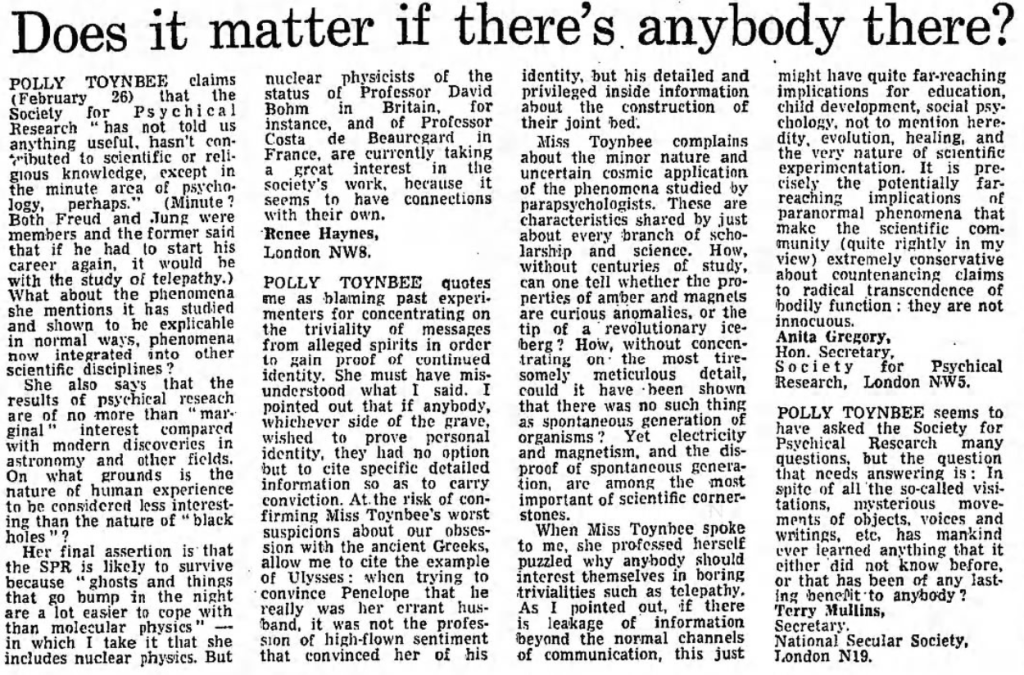
Anita Gregory (1925-1984) was a German-born British psychologist and parapsychologist, known for her critical investigations into paranormal phenomena. Best known for her skeptical take on the Enfield Poltergeist, Anita also wrote or translated significant works in the field.
This updated resource guide aims to put all relevant information about Anita Gregory’s contributions to fields of paranormal study in one place.
What did Anita Gregory do that was so influential?
- Anita Gregory conducted extensive research and published significant works.
- Anita Gregory provided one of the most thorough skeptical examinations of the famous Enfield Poltergeist case.
- Anita Gregory bridged cross-cultural divides in parapsychological research.
1. Anita Gregory conducted extensive research and published significant works.
Anita Kohsen was born on June 9, 1925, in Berlin, Germany to a Jewish family. She was forced to flee Nazi Germany, hiding out in a Belgian convent before eventually relocating to Britain. In England, she was free to pursue a higher education. After studying languages at Birkbeck College, London, she expanded her academic horizons at Oxford University, studying politics, philosophy, economics, psychology, and physiology at St. Hugh’s College.
In 1949, Anita took an interest in the alleged paranormal phenomena produced by Austrian medium Rudi Schneider. Rudi Schneider was a controversial figure in the world of physical mediumship, known for séances where objects seemingly moved on their own.
Anita’s efforts to investigate the case for herself led to her meeting physicist and parapsychologist Clive Gregory, who she married in 1954. Their marriage began a promising personal and professional collaboration which lasted until Clive’s untimely death in 1964, when he was killed in a car accident.
Anita critically examined several notable cases which she later wrote about in her PhD thesis. Her thesis focused on problems researchers may encounter when investigating cases of psychokinesis:
- Rudi Schneider: Anita analyzed investigations of the Austrian medium, challenging claims of fraud by other researchers.
- Matthew Manning: Anita conducted experiments with the British psychic, producing an 85-page report in 1982 that provided valuable insights into the role of the experimenter.
- Enfield Poltergeist: Anita investigated the case, expressing skepticism and suggesting that some phenomena were exaggerated or staged.
2. Anita Gregory provided one of the most thorough skeptical examinations of the famous Enfield Poltergeist case.
The Enfield Poltergeist case, which transpired in a North London council house between 1977 and 1979, became one of the most publicized paranormal investigations in British history. The case centered on sisters Janet and Margaret Hodgson, who allegedly experienced supernatural phenomena including furniture moving on its own, knocking on walls, and Janet speaking in a gruff male voice claiming to be the spirit of a previous resident named Bill Wilkins.
While many paranormal investigators believed in the authenticity of the phenomena, Anita Gregory emerged as perhaps the most formidable skeptic of the case. As a prominent member of the Society for Psychical Research (SPR), Anita visited the Hodgson home during the months when the poltergeist’s activity was at its height.
Anita’s skepticism was fueled by several observations and discoveries. Most notably, Janet’s attempt to physically bend spoons and an iron bar caught on video tape—clear evidence of deception. Anita also observed that the phenomena tended only to occur when not being directly watched, and that the girls’ behavior often changed dramatically when they thought they weren’t being observed.
In her doctoral thesis, Anita concluded that the Enfield case was “spurious” and that “the effects, at any rate those observed by myself, were wholly spurious and/or pathological.” She characterized the Enfield case as having been “overrated” and described the evidence as “greatly exaggerated.” She speculated that the girls had staged incidents specifically for journalists seeking sensational stories.
Anita’s work on the Enfield case demonstrates her willingness to challenge popular paranormal claims. For her critical analysis and direct investigation was paramount, even when such skepticism might place her at odds with other researchers in her field.
3. Anita Gregory bridged cross-cultural divides in parapsychological research.
Anita’s undergraduate study of languages allowed her to transcend cultural barriers to research collaboration. Although originally from Germany, Anita succeeded in both English and Russian as well as German.
During the Cold War era, significant parapsychological research was being conducted in the Soviet Union, often isolated from Western scientific communities due to political tensions and language barriers. Anita played a crucial role in bridging this gap through her linguistic skills and academic connections.
In 1962, Anita translated a groundbreaking study of ESP by the prominent Russian parapsychologist L.L. Vasiliev. This translation was published the following year by the Institute for the Study of Mental Images (which Anita had founded with her husband) under the title Experiments in Distant Influence. It was reissued in 2002 under the title Experiments in Mental Suggestion. Anita’s translation made important Soviet research accessible to Western parapsychologists during a time of limited scientific exchange between East and West. Anita also edited a collection of writings by Sir Cyril Burt on psychical research, published as “ESP and Psychology,” further contributing to the academic literature on parapsychology.
Anita’s academic standing and contributions were recognized when she was awarded the gold medal of the Swiss Vereinigung für Parapsychology (Parapsychology Union) of Zurich in 1972. In 1980, she joined the council of the Society for Psychical Research, serving for five years as honorary secretary.
Anita Gregory’s dual legacy as both a serious parapsychological researcher and a skeptical investigator provides an important model for balanced inquiry in the field. By acknowledging and modeling her commitment to the critical examination psi claims, we inevitably gain a more nuanced understanding of psychical phenomena.
Read More . . .
- Physical and Psychical Research: An Analysis of Belief (1954)
- A New Theoretical Basis for Psi (1956)
- The O-Structure: An Introduction to Psychophysical Cosmology (1958)
- Experiments in Distant Influence: Discoveries by Russia’s Foremost Parapsychologist (1962, translator of L.L. Vasiliev’s work)
- ESP and Psychology (1975, editor of Cyril Burt’s writings)
- Problems in Investigating Psychokinesis in Special Subjects (1978)
- The Strange Case of Rudi Schneider (1985)
- Experiments in Mental Suggestion (2002, translator of L.L. Vasiliev’s work)
 PARANORMAL WOMEN: A Hidden History