The Woman Who Created a Ghost
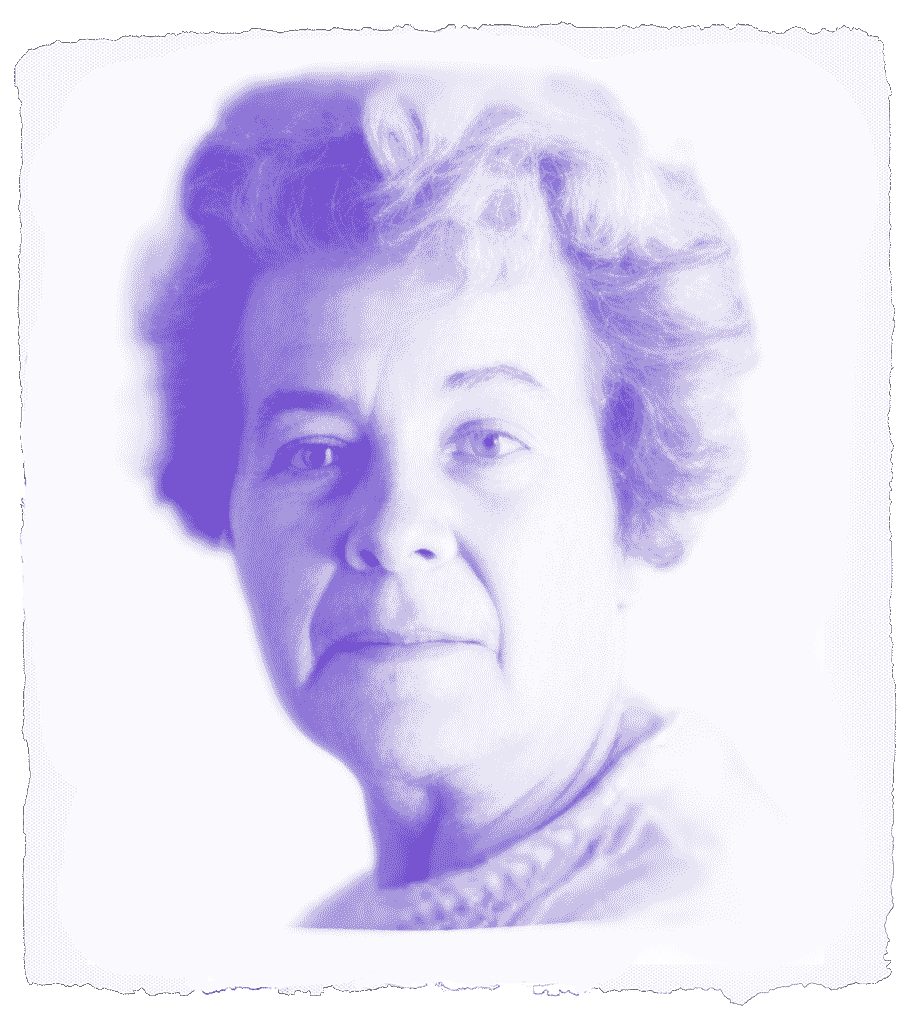
Iris Owen (1916–2009) was a British-born registered nurse and psychical researcher known for her contributions to the study of poltergeist phenomena and psychokinesis. She married parapsychologist A.R.G. (George) Owen in 1952, and together they immigrated to Canada in 1970, where they conducted pioneering experiments in psychical research.
This updated resource guide aims to put all relevant information about Iris Owen’s contributions to fields of paranormal study in one place.
What did Iris Owen do that was so influential?
- Iris Owen conducted the famous “Philip Experiment.”
- Iris Owen studied numerous poltergeist cases.
- Iris Owen investigated the notorious Borley Rectory.
1. Iris Owen conducted the famous “Philip Experiment.”
Perhaps Iris Owen’s most significant contribution to parapsychology was her leadership of the groundbreaking “Philip Experiment” in 1972. This experiment, which would dramatically change our understanding of séance phenomena, began with a provocative question: Could a group of ordinary people create a ghost through collective imagination and will?
Owen assembled a diverse group of eight participants, none of whom were trained mediums or claimed psychic abilities. The group included Margaret Sparrow (former chairperson of MENSA in Canada), industrial designer Andy H. and his wife Lorne, heating engineer Al Peacock, accountant Bernice M., bookkeeper Dorothy O’Donnel, and sociology student Sidney K. Together, they created a detailed biography for a fictional 17th-century English aristocrat they named Philip Aylesford.
Philip’s fictional history was deliberately crafted with general historical accuracy yet contained deliberate contradictions. According to their creation, Philip was born in 1624 in England, had an early military career, and was knighted by sixteen. He became friends with Charles II, working as a spy during the English Civil War. Unhappily married to a woman named Dorothea, Philip fell in love with a Romani girl who was later accused of witchcraft and burned at the stake. Overcome with grief, Philip committed suicide in 1654 at age thirty.
The group initially conducted traditional séances, sitting around a table in well-lit conditions, attempting to contact their fictional creation. These early sessions yielded nothing. However, when Owen altered the environment to mimic traditional séance conditions by dimming the lights, remarkable phenomena began to occur. Participants reported feeling a presence, experiencing table vibrations, sensing unexplained breezes, and hearing distinctive rapping sounds that responded intelligently to questions about Philip’s life.
The table around which they sat began to demonstrate seemingly impossible movements—tilting on a single leg and moving across the room without human contact. These phenomena were documented on audio and video recordings and witnessed by numerous observers, including journalists. What made these results so remarkable wasn’t just the physical phenomena but what they revealed about the nature of such occurrences.
The Philip Experiment effectively demolished what Owen called the “spirit hypothesis”—the notion that séance phenomena necessarily required communication with the deceased. Since Philip was entirely fictional, any “communications” from him couldn’t possibly come from a real spirit. Instead, the experiment suggested that physical phenomena in séances could be produced through the collective psychokinetic influence of the sitters themselves, a hypothesis that dramatically reconfigured theories about poltergeist activity and hauntings.
Iris Owen, along with participant Margaret Sparrow, detailed these findings in their 1976 book Conjuring Up Philip: An Adventure in Psychokinesis. The experiment’s implications were profound—suggesting that human consciousness itself might directly influence physical reality through means not yet understood by science. The experiment was replicated several times with different fictional characters, including one named “Lilith,” with similar results.

2. Iris Owen studied numerous poltergeist cases.
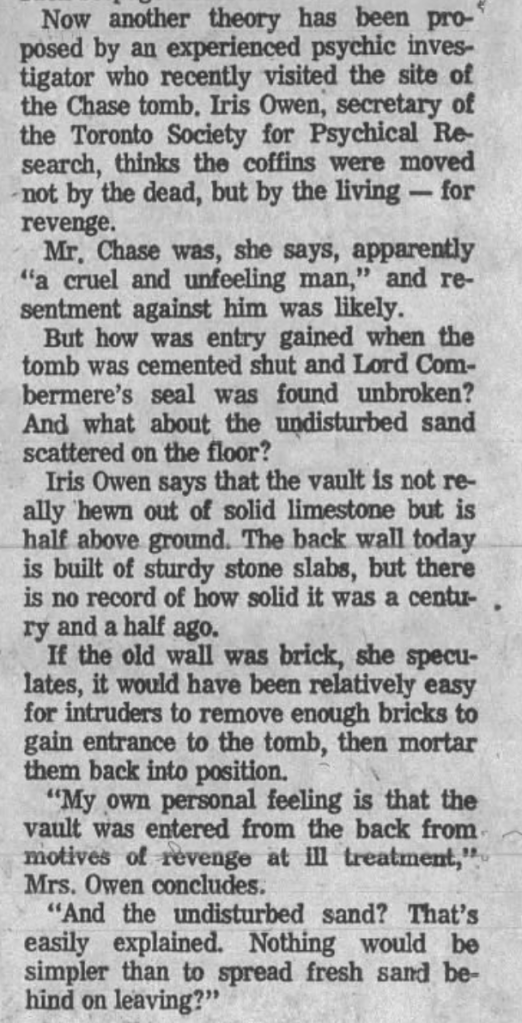
Iris and her husband mathematician and parapsychologist Dr. Alan Robert George Owen (commonly known as George) shared a passionate interest in unexplained phenomena, particularly poltergeists. The couple moved from England to Canada in the late 1960s after George received an invitation to direct parapsychological research at the Toronto-based New Horizons Research Foundation. They agreed to conduct full-time research for the foundation for a period of five years. In Toronto, Iris became secretary of the Toronto Society for Psychical Research while assisting her husband’s work at the foundation.
Together they analyzed numerous case studies of poltergeist phenomena and came to the controversial conclusion that some poltergeist phenomena were genuine physical occurrences rather than hoaxes or misperceptions.
One of their most notable investigations involved the case of Matthew Manning, an eleven-year-old British schoolboy who became the focus of poltergeist activity in 1966. The Owens investigated this case over several years, and in 1974, the then-teenage Manning visited them in Ontario for further experiments into his psychic abilities.
What made the Owens’ approach to poltergeist research revolutionary was their rational, non-supernatural framework for understanding these phenomena. Rather than attributing poltergeist activity to mischievous spirits or demons, they proposed that such occurrences were unconsciously created by living individuals experiencing severe emotional stress. As writer Victoria Branden noted, “This rational and non-superstitious approach by the Owens had had a powerful effect in turning the attention of theorists and experimenters from supernatural interpretations of so-called paranormal events to a search for rational explanations”.
Their work suggested that poltergeist phenomena represented a form of externalized psychokinesis—an unconscious “cry for help” from individuals (often adolescents) unable to express their emotional turmoil through conventional means. This perspective aligned with the findings of their Philip Experiment, suggesting that the human mind itself might be capable of directly influencing physical reality through psychokinetic means.
3. Iris Owen investigated the notorious Borley Rectory.
In 1979, Iris and fellow researcher Pauleen Mitchell published “The Alleged Haunting of Borley Rectory” in the Journal of the Society for Psychical Research, bringing a more methodical approach to this famous haunting case. The Owens interviewed Marianne Foyster, a key figure in the Borley Rectory hauntings, and recorded her version of events. Borley Rectory, often called “The Most Haunted House in England,” which is a controversial subject for paranormal investigators.
The Owens’ investigation of Borley Rectory stood out for its thoroughness and objectivity. While many researchers had approached the case with either uncritical belief or dismissive skepticism, the Owens sought to separate verifiable facts from speculation. As they noted in their research, “Borley is unique in its complications and admixture of truth and fraud”. Their work helped move the field toward a more nuanced understanding of haunting cases, recognizing that such phenomena often involve complex combinations of genuine anomalous events, misperceptions, and occasional deliberate deception.
Iris and her husband George, a classic collegial couple, approached paranormal research with an open-minded willingness to follow evidence wherever it led. She and George neither dismissed paranormal claims outright nor accepted them uncritically. Instead, they developed experimental protocols to test specific hypotheses about unexplained phenomena.
Read More . . .
 PARANORMAL WOMEN: A Hidden History