Shamanic Healer and Psychologist
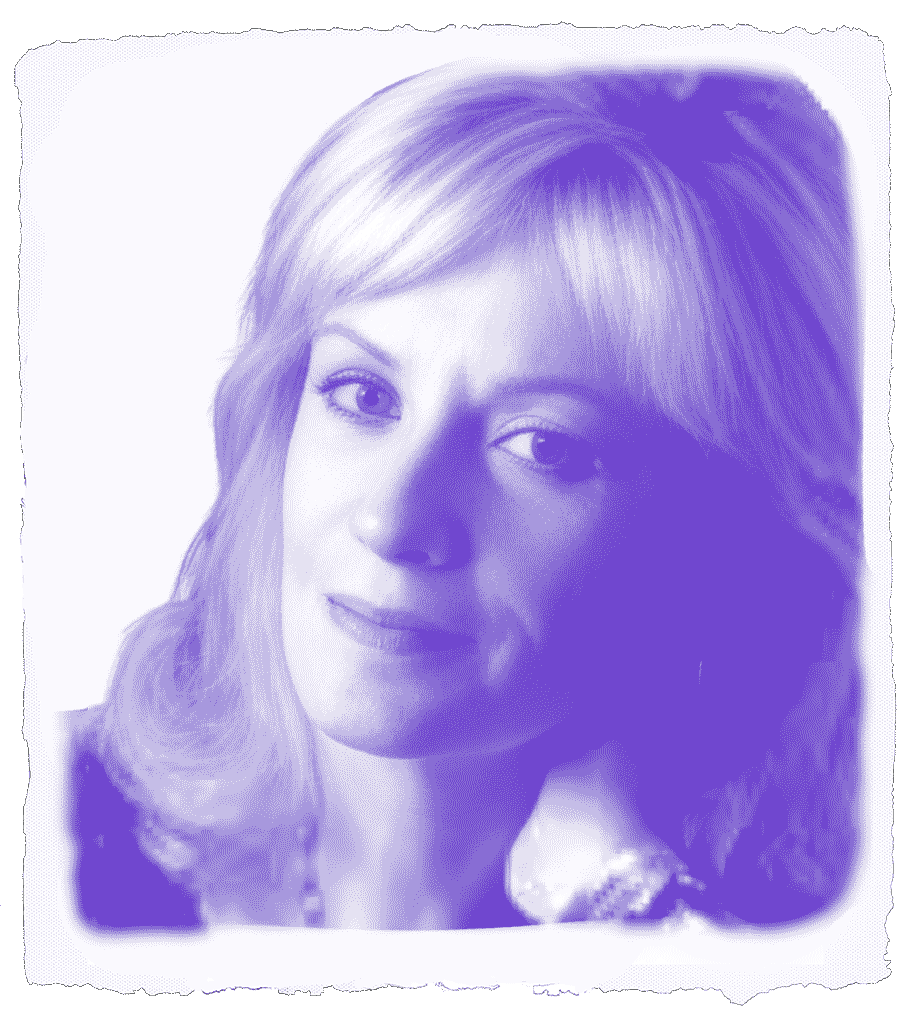
Jeanne Achterberg (1942-2012) was an American psychologist renowned for her pioneering work in mind-body medicine, particularly the therapeutic application of guided imagery and creative visualization. She earned her Ph.D. in General Experimental Psychology from Texas Christian University and served as a faculty member at Southwestern Medical School for 11 years. Later, she became a Professor of Psychology at the Saybrook Institute in San Francisco.
This updated resource guide aims to put all relevant information about Jeanne Achterberg’s contributions to fields of paranormal study in one place.
What did Jeanne Achterberg do that was so influential?
- Jeanne Achterberg found applications for shamanic rituals that could benefit Western medicine.
- Jeanne Achterberg reclaimed women’s ancient role as healers.
- Jeanne Achterberg conducted pioneering research in Remote Healing.
1. Jeanne Achterberg found applications for shamanic rituals that could benefit Western medicine.
Jeanne Achterberg’s landmark 1985 book, Imagery in Healing: Shamanism and Modern Medicine, established her as a pioneering voice connecting ancient healing traditions with contemporary medical practice. In this influential work, Jeanne meticulously examined how the systematic use of mental imagery could positively influence disease progression and help patients cope with pain. Her research demonstrated that visualization techniques similar to those employed by traditional shamans could activate biological pathways now recognized in contemporary medicine.
Jeanne’s innovative approach emerged from her comprehensive study of shamanic traditions, which she described as “the medicine of the imagination.” She methodically traced the historical use of imagery within Western medicine while presenting contemporary examples of health professionals harnessing the power of imagination through methods like hypnosis, biofeedback, and the placebo effect. Her work provides compelling evidence that the healing practices of ancient shamans weren’t merely superstition but sophisticated applications of mind-body principles that modern science was only beginning to comprehend.
What distinguished Jeanne’s work from many of her contemporaries was her rigorous scientific approach. She connected visualization practices to the science of immunology, presenting data demonstrating how imagery could directly and profoundly impact immune system function. This evidence-based approach gave scientific legitimacy to healing concepts often dismissed by conventional medicine, creating an important bridge between traditional healing wisdom and contemporary scientific understanding.
2. Jeanne Achterberg reclaimed women’s ancient role as healers.
In her influential 1990 book, Woman as Healer, Jeanne explored the historical role of women in Western healing traditions. This groundbreaking work drew from various disciplines including history, anthropology, botany, and archaeology to examine cultures where women worked as independent and honored healers. She documented the systematic persecution of women healers during the witch hunts of the Middle Ages, connecting this dark period to the later development of midwifery and nursing as women’s professions in the nineteenth century.
Jeanne argued that women persecuted during medieval European witch trials were actually shamanic practitioners. While this interpretation is contested by some scholars, Jeanne’s work highlights how female healers utilizing natural remedies, spiritual practices, and intuitive methods were systematically marginalized by their male counterparts in various societies. She traced this historical trajectory to the present day, examining contemporary roles of women in healing professions during a time of healthcare crisis that coincided with the reemergence of feminine values in medicine.
This work was particularly significant for paranormal research because it illuminated how gendered power dynamics influenced which healing and spiritual practices became accepted within mainstream institutions versus those relegated to the realm of superstition or the “occult.” By reclaiming women’s historical contributions to healing traditions, Jeanne helped contextualize and legitimize practices and phenomena that had been dismissed or pathologized by dominant medical paradigms.
3. Jeanne Achterberg conducted pioneering research in Remote Healing.
Perhaps Jeanne’s most significant contribution to paranormal research was her groundbreaking work on distant intentionality—the concept that directed thoughts could affect another person from a distance. In a remarkable study using functional magnetic resonance imaging (fMRI) technology, Jeanne Achterberg and her colleagues demonstrated measurable correlations between distant intentionality and brain function changes in recipients.
The study recruited eleven healers from Hawaii who claimed abilities in some form of healing at a distance. Each healer selected a person with whom they felt a special connection as a recipient. These recipients were placed in fMRI scanners and completely isolated from all forms of sensory contact with the healers. The healers then sent forms of distant intentionality at random two-minute intervals unknown to the recipients.
The results were striking. Significant differences between experimental (“send”) and control (“no send”) groups were found, suggesting that whatever the remote healers were doing had a measurable effect on recipients’ brains.
The study concluded that remote healers could indeed make intentional connections with sensory-isolated individuals affecting their brain function. This research provides compelling scientific evidence for phenomena often associated with paranormal experiences, challenging conventional understandings of consciousness and human connection.
By maintaining scientific integrity while exploring spiritually significant topics, Achterberg created space for serious academic consideration of paranormal phenomena. Her legacy reminds us that the boundaries between science and spirituality are more permeable than conventional paradigms might suggest, and that ancient wisdom traditions often contain profound insights that can inform and enhance contemporary understanding.
Read More . . .
 PARANORMAL WOMEN: A Hidden History