

Teacher of the Paranormal
Margaret L. Anderson (1920-1986) was a former high school teacher and principal who became a pioneering parapsychologist. Her work in the mid-20th century helped shape our understanding how extrasensory perception (ESP) can be affected by social dynamics. Her fascination with the potential role of psi phenomena in education led her to a position at the Duke University Parapsychology Laboratory in 1954, and later, to the University of Pittsburgh.
This updated resource guide aims to put all relevant information about Margaret Anderson’s contributions to fields of paranormal study in one place.
What did Margaret Anderson do that was so influential?
- Margaret Anderson studied how interpersonal relationships affect psi ability.
- Margaret Anderson conducted ESP with children in educational settings.
- Margaret Anderson led the Parapsychological Association.
1. Margaret Anderson studied how interpersonal relationships affect psi ability.
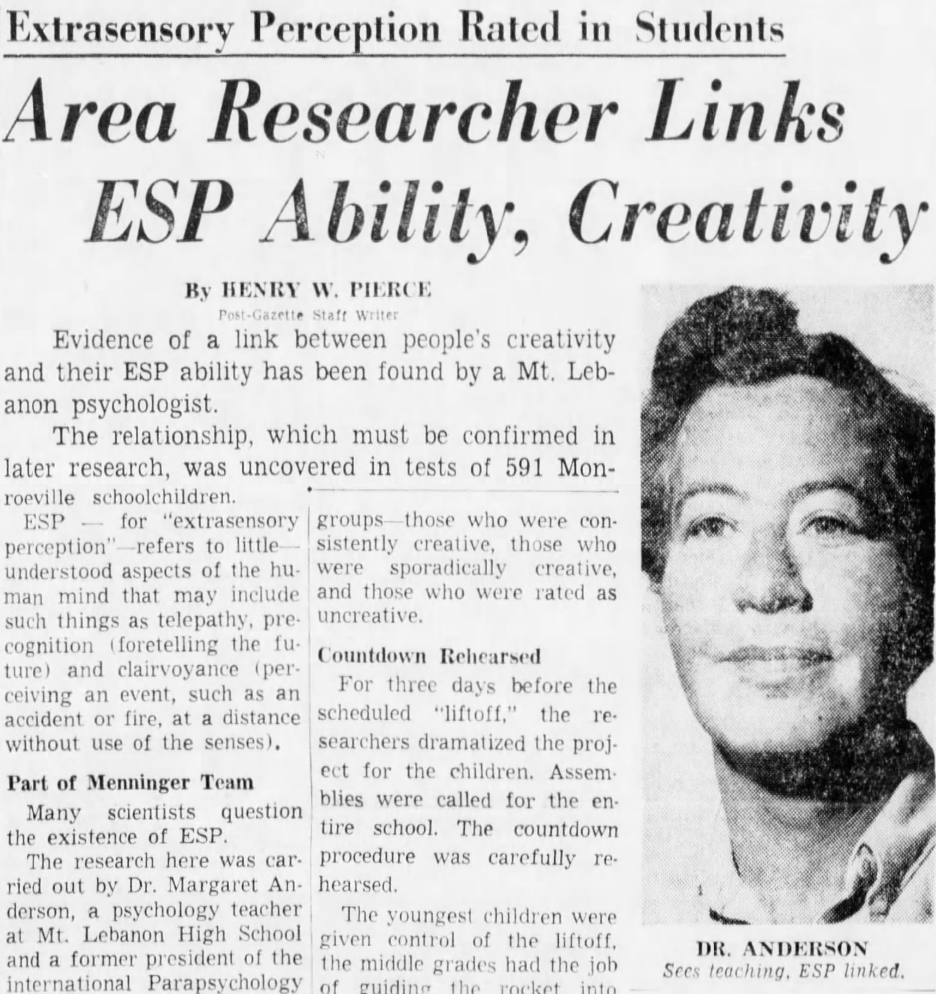
Perhaps Margaret Anderson’s most notable contribution to parapsychology came through her collaborative work with fellow researcher Rhea White. Together, they conducted what became known as the “Anderson-White school experiments,” a series of innovative studies examining how emotional dynamics between teachers and students might influence ESP performance. Margaret had developed a theoretical foundation based on the hypothesis that “psi may play a direct role in the educational process as mediated by the teacher-pupil relationship.” This forward-thinking approach represented one of the first serious attempts to examine how interpersonal relationships might affect paranormal abilities.
The experiments yielded fascinating results, demonstrating that the extent of ESP displayed by children was significantly affected by the emotional quality of their relationship with the teacher administering the test. Specifically, Margaret and Rhea predicted that positive teacher-pupil relationships would enhance ESP performance, while negative relationships would inhibit such abilities. They conducted extensive tests of clairvoyance and precognition to evaluate this theory, publishing their findings in multiple papers throughout the late 1950s. While subsequent researchers were unable to fully replicate their findings, the Anderson-White experiments were groundbreaking in their approach to studying the social and emotional factors that might influence psi phenomena. These studies represented a departure from purely mechanical or statistical approaches to ESP research, introducing considerations of psychological and interpersonal dynamics that expanded the field’s conceptual framework.
2. Margaret Anderson conducted ESP with children in educational settings.
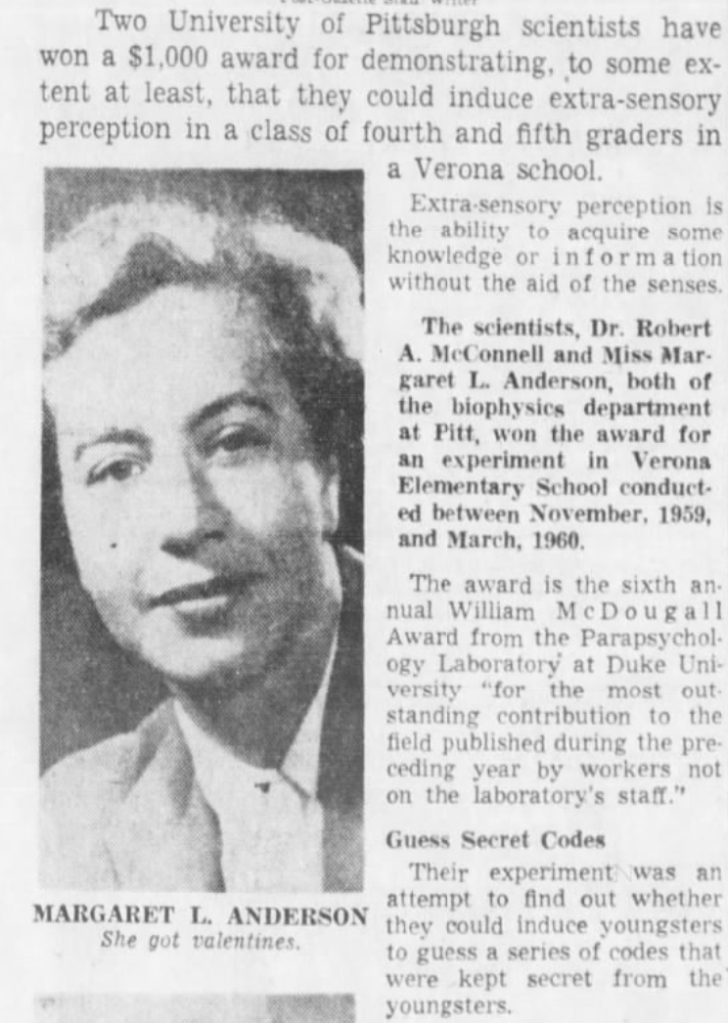
Margaret’s innovative approach to ESP testing methodology constituted another significant contribution to parapsychology. Moving beyond traditional card-guessing paradigms, she developed techniques that incorporated elements of fantasy and imagination to create situations more conducive to eliciting ESP results. This creative approach culminated in her co-authored paper with R.A. McConnell titled “Fantasy Testing for ESP in a Fourth and Fifth Grade Class.”
This groundbreaking research earned Anderson and McConnell the prestigious McDougall Award in 1961, recognizing their article published in the Journal of Psychology that same year. The work was considered particularly valuable for its methodological innovations and for demonstrating how ESP testing could be integrated into natural educational settings. Margaret’s approach recognized that children’s imaginative capabilities might provide a more fertile environment for ESP manifestation than the sterile laboratory conditions typical of earlier ESP research. Her methods helped bridge the gap between controlled experimental research and real-world applications, suggesting practical ways that paranormal phenomena might operate in everyday educational contexts. The recognition through the McDougall Award highlighted the significance of Margaret’s methodological contributions to advancing parapsychological research techniques.
3. Margaret Anderson led the Parapsychological Association.
Beyond her experimental research, Margaret Anderson made substantial contributions to the field through her organizational leadership. She was an active member of the Parapsychological Association, serving as its treasurer and eventually ascending to the role of president in 1962. This leadership position came at a critical time in the development of parapsychology as a field seeking scientific legitimacy and institutional recognition.
As president of the Parapsychological Association, Margaret helped guide the organization during its formative years, working to establish parapsychology as a respectable field of scientific inquiry. Her dual background as both an educator and researcher positioned her uniquely to bridge the gap between academic institutions and parapsychological research. Through her leadership, Margaret helped foster a more rigorous and systematic approach to the study of paranormal phenomena, advocating for methodological standards that would enhance the field’s scientific credibility. Though she gradually withdrew from parapsychological circles after beginning her career teaching at the University of Pittsburgh (where she received her PhD in 1962), her early leadership helped establish organizational foundations that continue to support parapsychological research today.
Margaret L. Anderson’s career demonstrates the valuable intersection of educational expertise and parapsychological inquiry. Her work investigating the role of teacher-pupil relationships in ESP performance, her innovative fantasy-based testing methods, and her organizational leadership all contributed significantly to the advancement of parapsychology as a field of study.
 PARANORMAL WOMEN: A Hidden History